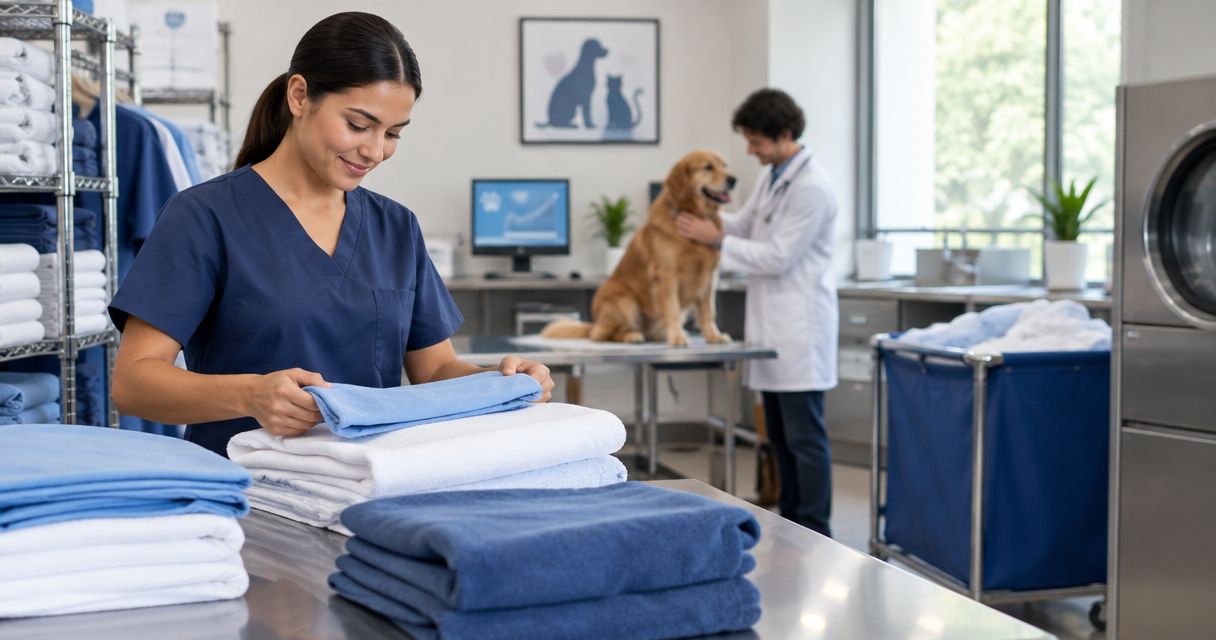
Veterinary clinic laundry service is the collection, washing, drying, and return of reusable textiles to keep patient-care supplies moving without tying up your team. Unlike household laundry, clinic loads need clear rules for animal-contact items, contamination, and clean storage—not just a fresh smell and a tidy fold.
- Choose laundry service for veterinary clinics by textile acceptance and infection-control requirements, not pickup convenience alone.
- Hampr provides business laundry pickup, wash, fold, and delivery; confirm veterinary-item acceptance before sending anything.
- Keep routine laundry, isolation textiles, and items needing special processing on separate, documented routes.
- Build your 2026 pickup schedule around measured textile use and confirmed return timing.
Why laundry service matters for veterinary clinics
Your towels and blankets move through exam rooms, kennels, treatment areas, and storage. A useful laundry plan accounts for where each item has been and what processing it needs before reuse. The label on the bag matters as much as the calendar reminder.
For your 2026 plan, separate two decisions: which textiles can leave the clinic, and who can process them appropriately. Convenience comes after acceptance and clinical requirements. An ordinary wash-and-fold service should never become the default destination for every used textile.
Hampr offers on-demand pickup, wash, fold, and delivery for households and businesses in select US cities. That describes the service model, not a veterinary-processing specification. Confirm your location, textile types, and handling requirements directly before choosing a provider.
Hampr is best considered for routine business laundry, with veterinary textiles subject to explicit provider acceptance.
Set up a clinic laundry process that staff can follow
1. Map every textile before choosing a service
Start with a clipboard or shared spreadsheet. Walk through the clinic and record what you actually wash: kennel towels, washable bedding, staff clothing, cleaning cloths, and any reusable clinical textiles. Do not put them all under one cheerful heading called laundry.
Ask your clinical lead to assign each category a processing route. Record the item’s intended use, manufacturer care instructions, and any clinic restrictions. A washable label tells you how a fabric tolerates cleaning; it does not establish whether an outside provider accepts its use history.
For your 2026 baseline, keep a 7-day usage log as a practical starting point. Record individual pieces where possible, rather than describing everything as a full basket. Extend the log when that week does not reflect normal operations.
- List textile types by room or department.
- Record daily pieces used and returned.
- Note care-label restrictions and damaged items.
- Assign a staff member to approve each processing route.
- Flag unknown contamination histories before collection.
2. Separate routine textiles from restricted loads
Create written sorting rules before the next pickup. Your clinical lead should define which used textiles qualify for routine processing and which require a separate infection-control route. Do not ask reception staff or a driver to make that decision at the door.
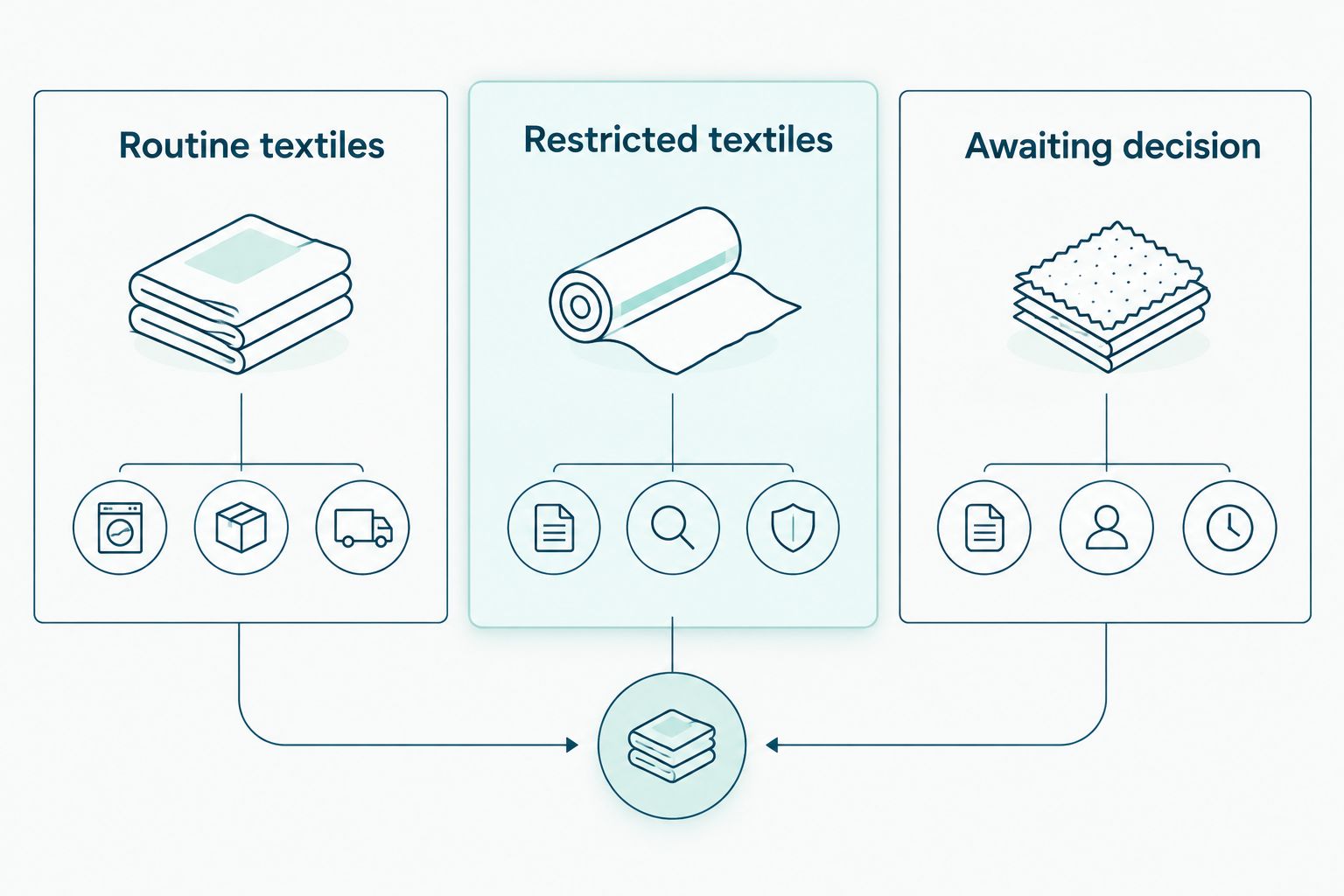
Use 3 routing categories as a planning template: routine textiles, restricted textiles, and items awaiting a decision. These are administrative categories, not clinical risk classifications. Your clinic’s protocols determine what belongs in each.
Routine does not mean visibly clean, and restricted does not mean especially smelly. Describe the actual use and contamination concern to the provider. Never conceal an item’s history to get it accepted, and do not send sharps, medications, or other clinical waste with laundry.
- Routine textiles: send only after provider acceptance.
- Restricted textiles: follow the clinic-approved processing route.
- Awaiting decision: hold apart until the clinical lead responds.
- Use suitable containment under clinic procedures.
- Keep clean returns away from used-laundry collection.
3. Check the provider’s acceptance rules in writing
Make a short requirements sheet before calling providers. Describe the textiles, their use, expected quantity, contamination concerns, and required return condition. Ask for written answers rather than relying on a general statement that a provider handles business laundry.
Hampr laundry pickup is an option to discuss for accepted routine business items. Its stated pickup, wash, fold, and delivery service does not establish acceptance of veterinary bedding, infectious materials, or reusable clinical textiles. No written acceptance means no handoff.
If your clinical protocol requires a defined disinfection process, ask the provider to document whether it can meet that requirement. Washing, disinfection, and sterilization are not interchangeable descriptions. Your clinical lead must approve the process for the item’s intended reuse.
- Describe animal contact and contamination honestly.
- Ask which textile categories the provider excludes.
- Confirm handling, packaging, and return requirements.
- Request relevant processing documentation where required.
- Name the person authorized to approve exceptions.
4. Match collection timing to your clean-textile supply
Use your usage log and a calendar to plan collections manually first. Count what the clinic needs while a load is away, then add a clinic-approved reserve. Do not base the plan on the fastest return mentioned in a conversation; use the timing agreed for your account.
A practical stock calculation is expected use during the confirmed return interval, plus your chosen reserve. Calculate that separately for towels, bedding, and other approved categories. A cupboard full of blankets does not solve a towel shortage.
For the 2026 schedule, assign someone to check clean stock before each collection. If an accepted pickup-and-delivery service removes washing and folding from the team’s workload, keep the stock check anyway. Outsourcing the wash does not outsource the need to know what is left.
- Record the agreed collection and return windows.
- Count clean stock by textile category.
- Set a reorder or escalation point for each category.
- Keep a documented backup processing route.
- Plan handoffs around clinic access and staffing.
5. Standardize the handoff and return inspection
Write a short checklist that works without the practice manager standing beside the bags. Name a handoff owner and a backup. Include the collection location, approved packaging, order identification, and how the clinic records what leaves.
Use 2 checkpoints: one before collection and one when the order returns. At collection, confirm the correct items and instructions. On return, check the order against your record and inspect for dampness, visible soil, damage, or an unexpected odor before putting items away.
These checks identify obvious problems; they do not prove microbiological safety. Keep items with an unresolved concern out of circulation and follow your clinical lead’s instructions. A neatly folded towel still needs to meet the clinic’s return criteria.
- Verify bag identification without patient-identifying details.
- Record the categories and quantities handed over.
- Keep pickup access separate from patient-care activity.
- Inspect returns before moving them into clean storage.
- Document discrepancies and assign follow-up.
6. Review workload, quality, and exceptions
Start with an approved routine category rather than moving the whole clinic’s laundry at once. Record staff handling time, returned quantities, service exceptions, and whether your reserve stayed adequate. Compare actual work, not the relief everyone expects to feel.
For your 2026 review, include the work that remains: sorting, bagging, handoffs, inspection, storage, and provider communication. A service can remove washing and folding while leaving those responsibilities with your team. That is a useful trade-off when it matches your needs.
Review the arrangement whenever textile use, clinical requirements, or provider terms change. Keep a copy of the current acceptance rules where staff can find it. An old agreement should not quietly become permission for a new type of load.
- Track staff minutes spent on each laundry task.
- Log missing, rejected, or returned-for-rewash items.
- Record interruptions caused by insufficient clean stock.
- Compare invoices with the agreed service scope.
- Reapprove the process after a material change.
Compare your clinic’s laundry options
The right option is the one that meets the textile’s requirements and your operating needs. Use this table to narrow the discussion, then verify the actual provider or in-house process. A service category is not evidence of a particular processing capability.
| Option | Best for | Main advantage | Key limitation |
|---|---|---|---|
| In-house laundry | Clinics with an approved process, equipment, and assigned staff | Direct control over scheduling and handling | Your team owns washing, maintenance, documentation, and interruptions |
| Routine pickup and wash-and-fold | Accepted everyday textiles that do not require a specialized process | Moves washing and folding outside the clinic | Veterinary-item acceptance and processing suitability need confirmation |
| Specialized textile processor | Items with documented processing requirements | Lets you assess a provider against specific clinical requirements | The provider must demonstrate suitability; its category name is not enough |
| Hybrid arrangement | Clinics with different requirements across textile categories | Keeps each category on an appropriate route | Staff must maintain clear separation and handoff records |
Hampr laundry pickup belongs in the routine-service discussion, subject to acceptance. It should not be treated as a specialized veterinary processor without explicit supporting information. The advantage is the stated collection-through-delivery service; the limitation is that veterinary processing requirements still need verification.
For questions about business volume, use the guide to on-demand laundry pickup for bulk business orders alongside a direct provider conversation. A bulk order still needs an approved contents list.
Common mistakes veterinary clinics make
Treating all animal-contact laundry as the same
An exam-room towel and bedding from an isolation area should not share a processing route just because both fit in a bag. Have your clinical lead define the distinction. Staff need an accessible sorting rule, not a judgment call during a busy handoff.
Confusing a clean appearance with approved processing
Visible inspection is useful for spotting problems, but it does not verify a required disinfection process. Keep appearance checks and processing documentation separate. Neither a pleasant scent nor a crisp fold replaces the clinic’s clinical requirements.
Scheduling collection before checking the cupboard
Sending every used towel away without checking clean stock turns a convenient pickup into a supply problem. Count by textile category before collection. Keep the reserve attached to actual usage and agreed return timing, not a guess about tomorrow’s appointments.
Leaving special instructions in one person’s messages
A handoff fails when only the practice manager knows which bags are approved. Put acceptance rules, restrictions, and escalation contacts in the clinic’s shared procedure. Update that procedure when the provider changes its requirements or the clinic introduces a new textile.
FAQ
What’s the best laundry service for veterinary clinics?
The best laundry service for veterinary clinics is one that explicitly accepts your textiles and meets their documented processing requirements. Compare routine pickup, in-house laundry, and specialized processing by category rather than choosing one route for every item.
Can Hampr handle veterinary clinic laundry?
Hampr provides pickup, wash, fold, and delivery for businesses, but veterinary-textile acceptance needs direct confirmation. Describe the items and contamination concerns before sending a load, and do not assume specialized clinical processing.
Can we send bedding from an isolation area to ordinary wash-and-fold?
Do not send isolation-area bedding to ordinary wash-and-fold without clinical approval and explicit provider acceptance of the required process. Follow your clinic’s infection-control procedure and keep these textiles apart from routine loads.
Does washing clinic towels sterilize them?
Ordinary washing is not sterilization. Reusable textiles must receive the processing required for their intended use, as defined by your clinical protocol and applicable manufacturer instructions.
How often should a veterinary clinic schedule laundry pickup?
Schedule pickup around measured textile use, clean stock, and the provider’s agreed return window. Keep a clinic-approved reserve and a backup route rather than assuming every order will return before supplies run low.
What should we check when clean laundry comes back?
Check order identity, quantities, dryness, visible cleanliness, condition, and packaging before storage. Hold items with unresolved concerns out of circulation; inspection does not replace verification of a required processing method.
Is outsourcing better than washing everything at the clinic?
Outsourcing is a better fit when an approved provider meets your requirements and removes work your team needs to hand off. In-house processing offers direct control but leaves equipment, staffing, and process management with the clinic.
One last thing
Test the written procedure with the person covering the next shift. Ask them where an unfamiliar bag goes, who approves it, and what happens if a return fails inspection. If they need to guess, fix the instructions before expanding your 2026 laundry arrangement. The best handoff is the one that still works when your usual laundry person is off.