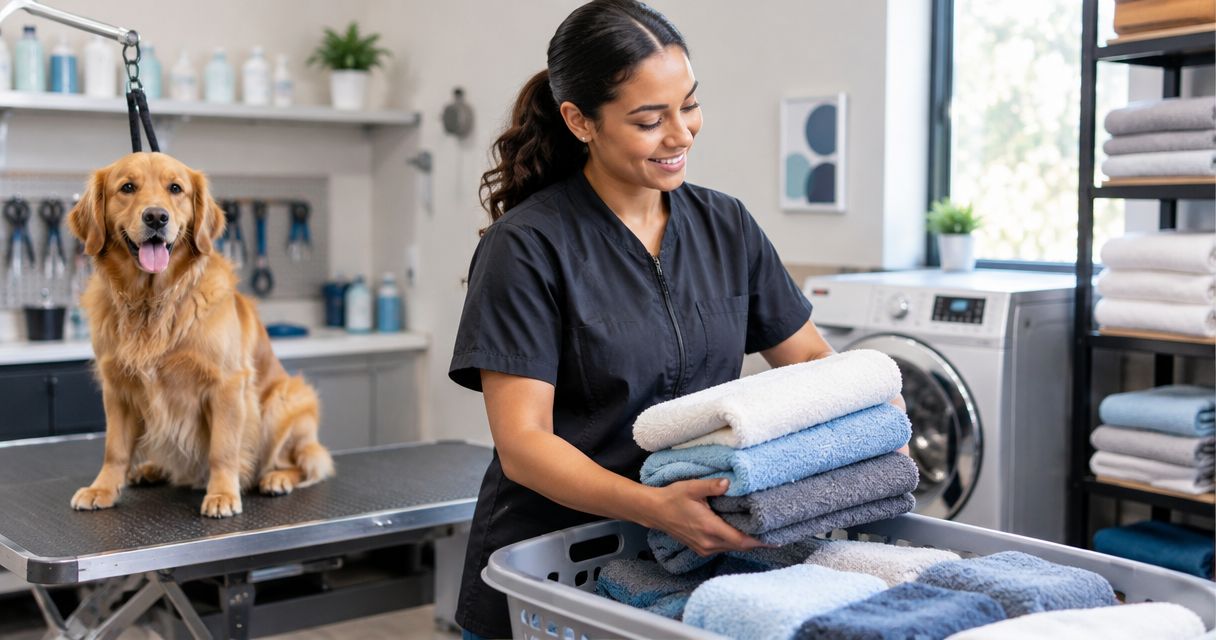
Dog groomers’ laundry service is the collection, washing, folding, and return of salon textiles with the aim of keeping clean towels ready for appointments. This 2026 guide explains how to choose a laundry service for dog groomers when pet hair, damp towels, and items needing special handling make ordinary wash-and-fold an incomplete answer.
- Choose a laundry service for dog groomers by textile acceptance, handling requirements, and dependable pickup—not convenience alone.
- Hampr provides business laundry pickup, wash, fold, and delivery in select US cities; confirm pet-salon textile acceptance.
- Keep routine grooming towels separate from items requiring special handling before arranging wash-and-fold.
- Test a complete pickup-and-return cycle before moving your whole towel supply off-site.
Why laundry pickup matters for dog groomers
A grooming appointment creates two jobs: getting the dog ready to go home and getting the workspace ready for the next dog. Towels sit right between them. If your clean stack runs short, someone has to stop another task and deal with laundry.
Pet salons also need more than a neat fold. You need a clear plan for loose hair, wet textiles, product residue, and anything outside routine washing. A folded towel is not proof of disinfection. Keep cleaning requirements separate from convenience when choosing a provider.
Hampr offers on-demand laundry pickup, wash, fold, and delivery for households and businesses in select US cities. Hampr is best for businesses seeking pickup, wash, fold, and delivery rather than collection alone. For a pet salon, the next question is whether your location and specific textiles fit the service.
The useful goal for 2026 is simple: make clean-towel replenishment a planned task instead of a closing-time surprise. Outsourcing the washing does not outsource your responsibility for sorting, storage, or deciding which items need separate treatment.
How to set up laundry pickup for your pet salon
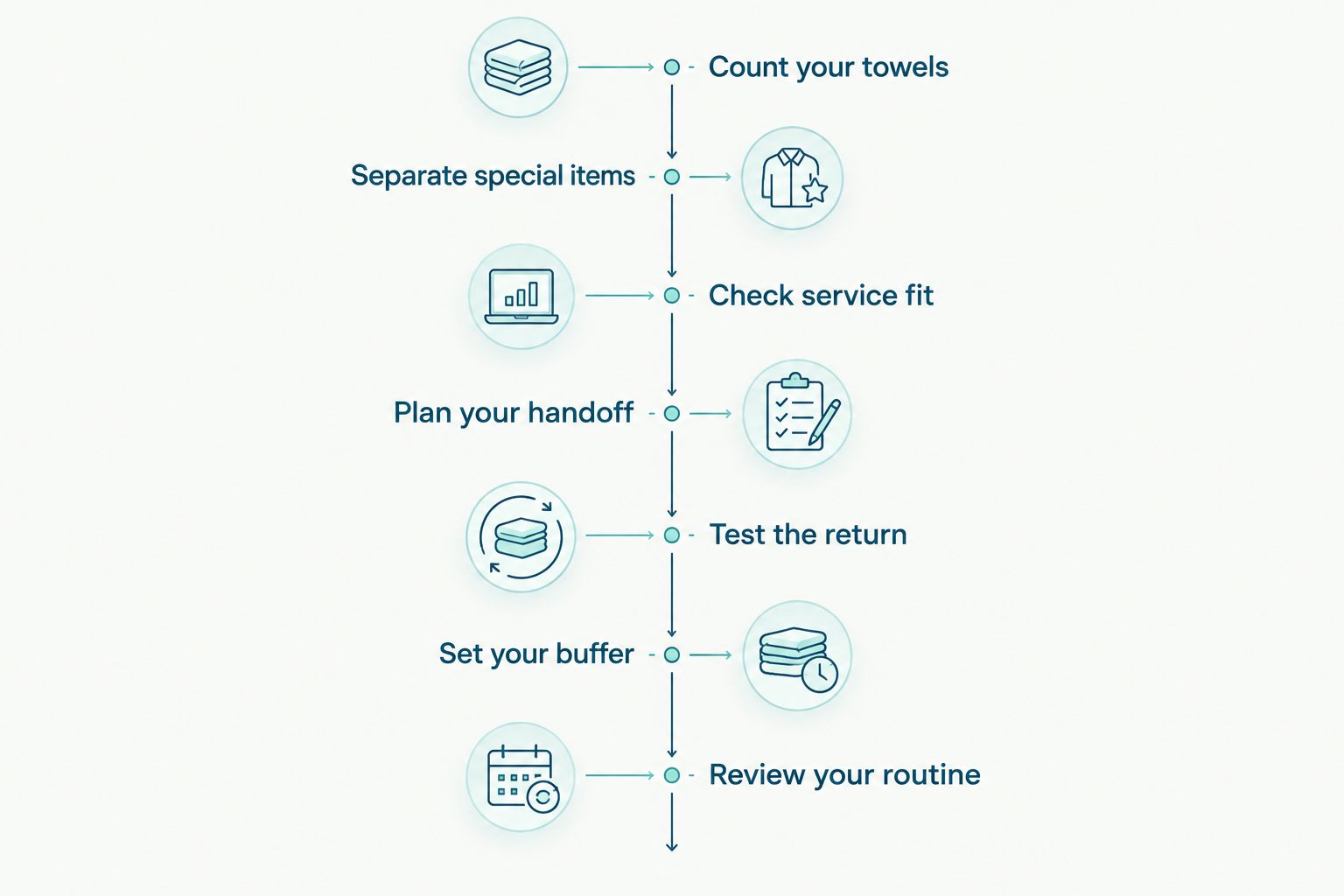
1. Count your towels
Start with a notebook or a basic spreadsheet. Record what your salon actually uses across 7 operating days, including a busy day and a quieter day. This is a suggested observation period, not a forecast of how much laundry your business produces.
Count towels by purpose rather than treating the whole cupboard as one pile. Bath towels, finishing towels, and washable bedding can have different care instructions and handling needs. Keep reusable cleaning cloths in their own category, too.
Record when clean towels become scarce, not just how many leave the shelf. A comfortable weekly total can still hide a shortage halfway through a busy afternoon. Your pickup plan needs to fit that moment, not an average that looks tidy on paper.
- Note the towel type and quantity used each day.
- Mark the point when your clean stack gets low.
- Record staff time spent washing, drying, and folding.
- List any items with different care instructions.
2. Separate special items
Build your sorting routine before comparing providers. Staff should know where routine grooming towels go and what must stay out of that collection. A bag should not become a mystery parcel simply because someone else will wash it.
Follow textile care labels, your salon’s infection-control procedures, and professional guidance for items associated with a suspected contagious condition. Do not send those items through an ordinary laundry route without explicit handling instructions and provider acceptance.
For everyday laundry, keep clean storage separate from used-textile collection. Remove loose debris in a designated dirty area, following your workplace procedures. Do not shake hair-covered towels over clean supplies or grooming equipment.
- Label the collection point for routine towels.
- Separate cleaning cloths from animal-contact towels.
- Set aside items needing special handling.
- Keep damp used textiles away from clean stock.
3. Check service fit
Make a short requirements sheet and use it for every provider conversation. You can do this yourself with an email: describe your business, the items you want washed, and their usual condition. Be direct about pet hair, grooming-product residue, and damp towels.
Hampr’s business laundry service offers the pickup, wash, fold, and delivery route that removes those tasks from your in-house workflow. It is an option to assess after you have defined your requirements—not a substitute for that assessment. Confirm location coverage and acceptance of your salon’s items before arranging service.
Your 2026 provider checklist should distinguish an advertised service from an agreed handling arrangement. A service that collects household laundry is not automatically a match for every pet-salon textile. Ask for clear answers before handing anything over.
- Confirm that your business address is served.
- Describe pet hair and the textiles you use.
- Ask about excluded items and preparation requirements.
- Explain any required washing or handling process.
- Confirm how collection and return are arranged.
4. Plan your handoff
Create a collection routine that a staff member can follow without asking the owner where everything goes. Start with a written checklist and a designated handoff location. If reception is also the pickup point, keep the laundry transfer separate from arriving pets and customers.
Use the provider’s actual packaging instructions rather than assuming any bag will do. Ask how the salon’s items should be identified and what happens if access is unavailable. A missed handoff is a workflow problem even when the washing itself is fine.
Write a separate return routine. Someone needs to receive the delivery, check its condition, and move it into clean storage. Pickup is only half the process; the towel is not ready for work until it is back where staff can find it.
- Assign a staff role to prepare the collection.
- Follow the agreed bagging and identification instructions.
- Record access details and a contact method.
- Keep the return area separate from used textiles.
5. Test the return
Use 1 complete pickup-and-return cycle as a trial before sending your entire working stock off-site. Choose routine items that the provider has agreed to accept. Keep enough clean towels on-site to operate while you evaluate the return.
Check the returned laundry against the requirements you wrote down. Look for remaining hair, noticeable residue, lingering odor, dampness, and sorting problems. A pleasant scent does not answer whether a towel is clean or suitable for its next use.
Assess the handoff as well as the wash. Did staff understand the instructions? Could the return be stored without another sorting session? Did communication resolve questions clearly? A trial should test the whole routine, not just whether the towels came back folded.
- Inspect the condition of returned towels.
- Check whether the items are fully dry.
- Compare the return with the agreed handling requirements.
- Record any issues before arranging another collection.
6. Set your buffer
Keep a clean reserve based on your measured usage and the provider’s confirmed return schedule. Do not build the plan around an unconfirmed same-day return. A reserve gives you room to keep working when laundry is away or a handoff needs rearranging.
You can manage this manually with a shelf label and a stock sheet. Separate the working stack from the reserve so staff can see when the salon is drawing down its backup. Update the sheet when laundry leaves and when clean items return.
For your 2026 schedule, account for busy appointment days, closures, and who receives deliveries. The right collection day is the one that keeps your towel supply workable—not necessarily the day that is easiest to remember.
- Use observed towel consumption to set the reserve.
- Plan around the confirmed return arrangement.
- Identify an alternative washing route before a disruption.
- Reorder clean storage after every return.
7. Review your routine
Check whether outsourcing removes work or simply moves it into bag preparation, chasing collections, and sorting returns. Keep a short task log before and during the trial. Compare the same activities so the result reflects your salon’s routine.
Look at the whole process: preparation, collection, communication, return checks, and storage. A laundry arrangement earns its place when it meets your textile requirements and fits the workday. Convenience alone is not enough if staff still have to rewash towels.
Review the process whenever appointment volume, towel types, or handling requirements change. What fits your salon in early 2026 should be reassessed when your operation changes. Keep the instructions somewhere staff can actually find them—not buried in the owner’s inbox.
- Compare staff handling time before and after the trial.
- Record missed handoffs and returned-item problems.
- Update the sorting instructions when requirements change.
- Keep the backup plan alongside the pickup checklist.
The routine follows a simple sequence: understand your towel use, define what belongs in the collection, confirm service fit, and test before committing your working stock.
Compare your salon’s laundry options
Choose the option that matches the work you need done and the handling your textiles require. In-house washing keeps the process on-site but leaves the work with your team. Outsourced washing removes some tasks, but introduces a handoff and requires a clean-stock plan.
The labels below describe the best fit for each approach, not a claim that every provider accepts grooming towels. For any outside service, confirm the actual arrangement before sending laundry.
| Option | Best for | Main advantage | Key limitation |
|---|---|---|---|
| In-house washing | Salons that need direct control of their washing process | Staff can follow the salon’s chosen sorting and care procedures on-site | Washing, drying, folding, and equipment upkeep remain salon tasks |
| Local drop-off wash-and-fold | Salons able to transport routine laundry themselves | Moves washing and folding outside the salon | Staff still handle transport; pet-textile acceptance needs confirmation |
| Hampr laundry pickup and delivery | Businesses seeking collection, wash, fold, and return | Includes the laundry journey as well as washing and folding | Operates in select US cities; confirm pet-salon textile acceptance |
| Specialist textile provider | Salons with defined handling requirements beyond routine wash-and-fold | Can be assessed against a written processing requirement | Suitability depends on the provider’s documented process and accepted items |
A specialist label is not proof of a particular treatment. Ask what the provider actually does, which items it accepts, and how that matches your written requirements. The same rule applies to every option in the table.
Explore business laundry pickup
Hampr offers pickup, wash, fold, and delivery in select US cities. Confirm your salon’s requirements.
Common mistakes dog groomers make with laundry pickup
Treating all salon textiles as ordinary towels
Bath towels, floor-cleaning cloths, bedding, and items needing special handling should not enter one collection by default. Their use and care requirements differ. Write down what belongs in routine pickup and what does not. Make that distinction visible at the collection point.
Assuming pickup includes a disinfection process
Pickup, washing, folding, and delivery describe a service workflow. They do not establish a disinfection method. When an item requires a specific process, confirm the requirement with an appropriate professional and verify the provider’s ability to meet it before collection.
Sending away the entire clean-stock safety net
An empty towel shelf is not a successful outsourcing plan. Keep a reserve matched to your usage and confirmed return arrangement. Test the service while your salon still has enough clean stock to operate without depending on an untested delivery.
Accepting fragrance as the quality check
A scented return is not your acceptance standard. Inspect towels for visible debris, dryness, residue, and suitability for use. Record problems clearly so the next conversation is about an observable issue rather than whether the laundry smells fresh.
Forgetting who owns the handoff
If everyone assumes someone else prepared the collection, the bags stay put. Assign preparation and receiving to named staff roles, with cover for absences. Your 2026 laundry plan needs an owner even when the washing happens elsewhere.
FAQ
What’s the best laundry service for dog groomers?
The best laundry service for dog groomers is one that accepts your salon’s textiles, meets their handling requirements, and fits your collection-and-return routine. Confirm pet hair, damp towels, excluded items, and any special processing needs before testing the service.
Does Hampr provide laundry pickup for businesses?
Hampr provides on-demand laundry pickup, wash, fold, and delivery for businesses in select US cities. Confirm that your salon’s address and pet-related textiles fit the service before arranging collection.
Can I send towels covered in dog hair to a laundry service?
Send hair-covered grooming towels only after the provider confirms acceptance and preparation requirements. Describe the condition accurately and follow the agreed instructions rather than treating them as ordinary household laundry.
Is wash-and-fold the same as disinfecting grooming towels?
Wash-and-fold is not a guarantee of a defined disinfection process. If your salon requires a particular treatment, obtain appropriate professional guidance and confirm the provider’s processing method before sending the items.
How many towels should I keep when laundry goes off-site?
Keep enough clean towels to cover your measured use while laundry is away, plus a reserve based on your operating needs. Use actual consumption and the confirmed return arrangement rather than a generic towel count.
Should a pet salon wash towels in-house or use pickup?
Use in-house washing when direct process control is the priority, and assess pickup when you want washing and transport handled outside the salon. Compare the entire workflow, including preparation, return checks, storage, and any special handling requirements.
How should I test a grooming-salon laundry service?
Test a complete collection-and-return cycle using routine items the provider has agreed to accept. Keep clean stock on-site and inspect the returned towels for dryness, remaining hair, residue, and compliance with your agreed requirements.
One last thing
Your towel cupboard is where the laundry service proves useful. If a return leaves staff hunting through mixed items or moving clean towels past dirty ones, fix the storage routine—not just the pickup schedule.
Give every returned towel a clear home before arranging the first collection. The aim is less laundry work, not a freshly folded sorting project at closing time.