Senior care facility laundry service is the collection, washing, drying, folding, and return of clothing and linens with the aim of keeping residents supplied with clean, correctly assigned items. This guide helps you choose laundry service for senior care facilities in 2026, where resident identification, care instructions, and infection-prevention requirements matter as much as getting the washing done.
- Choose laundry service for senior care facilities by textile needs, resident identification, and documented handling procedures.
- Hampr offers business laundry pickup, wash, fold, and delivery; confirm facility-specific requirements before choosing it.
- Separate everyday wash-and-fold needs from textiles requiring healthcare-specific handling.
- Test the complete pickup-to-closet process before moving your facility’s full laundry workload.
Why laundry service matters for senior care facilities
Laundry in senior care is more than a pile of towels. A resident’s cardigan needs to return to that resident, a care-label restriction needs to survive a shift change, and clean bedding needs a protected place to wait.
Choose a process that gets the right item back to the right person—not simply a service that returns folded bags. Review the basic laundry pickup and delivery process, then add the controls your facility requires.
Your setting determines the service brief. An independent-living community arranging personal laundry has different responsibilities from a skilled nursing facility managing healthcare textiles. The word senior does not tell a provider which handling procedures apply.
For your 2026 service review, separate convenience from care requirements. Pickup can remove washing tasks from staff schedules, but your facility still needs clear ownership of sorting, documentation, receiving, and resident distribution. Moving the washing off-site does not move those decisions with it.
How to build your facility’s laundry plan
1. Map your laundry before requesting service
Start with a paper log or spreadsheet. Record what leaves resident rooms, where it goes, who handles it, and how it returns. Follow an item all the way to the drawer or linen shelf; stopping at the laundry-room door misses the final handoff.
Use a 7-day observation period as a practical starting point for your review, not as an industry benchmark. Extend it if that period misses a regular bedding change or another recurring task. Record actual workload rather than estimating from occupied rooms.
Separate personal garments, shared linens, and items that need special assessment. Do not assume that everything washable belongs in the same service order. A wool sweater and a routine cotton towel can need very different care.
- List the clothing, bedding, towels, and other textiles you actually send.
- Record collection days and the staff roles handling each handoff.
- Flag care-label restrictions and items needing specialist review.
- Note where missing items, backlogs, or unclear instructions occur.
2. Define handling requirements with your care team
Write the facility’s requirements before comparing providers. Ask your infection-prevention lead or other responsible clinician to identify which textiles can enter an ordinary wash-and-fold process and which need a different arrangement.
Follow applicable requirements and your facility’s policies for soiled laundry. Avoid shaking soiled textiles, and keep clean returns separate from dirty collection areas. Do not treat a fragrance, a neat fold, or a visibly clean garment as proof that a required healthcare process occurred.
For the 2026 review, make the acceptance decision explicit. The person booking pickup should not have to decide at the collection point whether a bag is appropriate for an outside provider.
- Document which items are approved for each laundry route.
- Define the process for textiles requiring infection-prevention review.
- Specify protective handling and containment under facility policy.
- Require providers to explain their procedures before approval.
3. Match the provider to the approved workload
Build a short written service brief yourself, then use it to screen providers. Describe the textiles, identification needs, collection location, receiving responsibilities, and any care restrictions. Ask for written answers rather than relying on a general description of commercial laundry.
Hampr provides on-demand laundry pickup, washing, folding, and delivery for households and businesses in select US cities. That service description gives you a starting point for evaluating routine laundry; it does not establish healthcare-textile processing, resident-level tracking, or acceptance of your facility’s particular items.
Hampr is best considered by senior care teams seeking pickup, wash, fold, and delivery for routine laundry, subject to facility approval. Its potential fit is removing washing and folding from your in-house task list. The limitation is that your facility-specific handling needs still require confirmation.
- Send providers the same written description of your approved workload.
- Ask which items and handling instructions they accept.
- Confirm whether resident-level separation and return labeling are supported.
- Ask how exceptions, damaged items, and unresolved orders are handled.
4. Keep resident identity attached to each item
Start with your existing resident inventory and labeling process. Choose identifiers that staff can read consistently, and follow your privacy policies when information travels outside the facility. A room number alone creates confusion when residents move rooms.
Use only garment labels and attachment methods suited to the textile and acceptable to the provider. A label that disappears in the wash is not much help, and a loose note inside a mixed bag cannot identify every item after processing.
Decide who checks identity at collection and again at return. For personal laundry, returning a complete bag is not enough if the contents belong to different residents. Build the check into the workflow instead of leaving it to whoever opens the delivery.
- Apply the facility’s approved resident identifier consistently.
- Keep an inventory for items your team needs to track individually.
- Document whether bags remain separate throughout processing.
- Assign a staff member to resolve unidentified or mismatched items.
5. Turn garment preferences into clear instructions
Create a simple instruction sheet before submitting an order. Distinguish a resident’s preference from a requirement: preferred folding is different from a garment’s care-label restriction or a documented product sensitivity.
Read care labels rather than guessing from fabric appearance. Keep dry-clean-only, hand-wash, and other restricted items outside the routine order unless the provider explicitly accepts the required care. Do not assume that a general laundry service includes every cleaning method.
For detergent concerns, record the actual request and ask what the provider can follow. Avoid treating terms such as gentle or sensitive as interchangeable with a specific product restriction. Route health-related questions through the resident’s care team.
- Separate care-label requirements from optional folding preferences.
- Record detergent and fabric-softener instructions clearly.
- Ask how special instructions stay associated with the correct order.
- Hold back items whose required treatment has not been confirmed.
6. Design the collection and return handoffs
Draw the route on paper before adding calendar reminders or scheduling tools. Choose where staff prepare outgoing laundry, where the provider receives it, and where clean returns are checked. Keep those responsibilities clear across shifts.
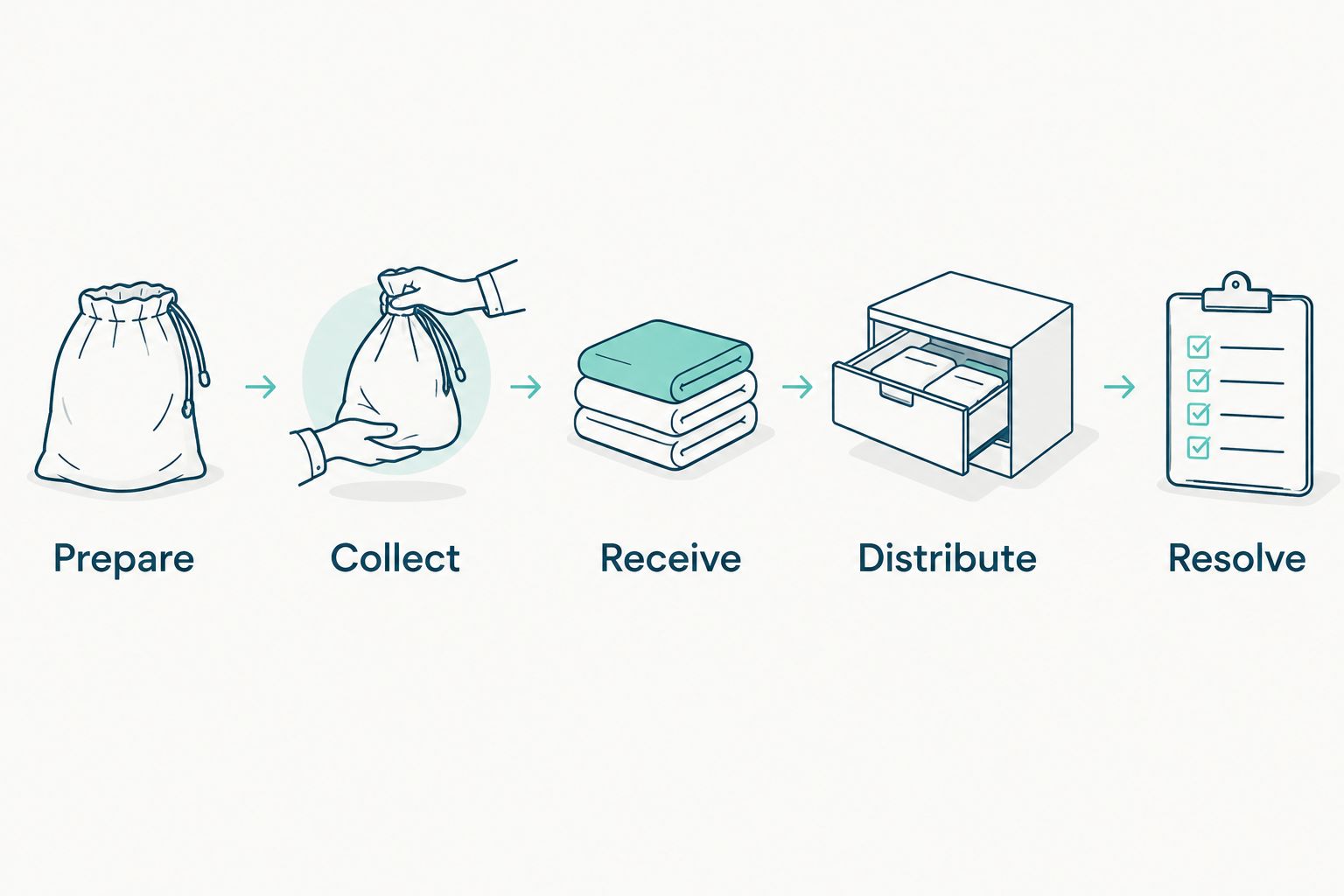
Use 3 handoff checkpoints in your plan: collection, receipt, and resident distribution. These are recommended control points, not a prescribed industry standard. At each checkpoint, name the person responsible and what that person records.
For your 2026 schedule, plan around the provider’s confirmed collection and return arrangements—not an assumed same-day cycle. Determine your reserve linen needs from actual use and the agreed service cycle. A calendar reminder cannot replace the clean bedding you need while an order is away.
- Prepare: Identify orders and attach approved instructions.
- Collect: Record what leaves and who accepts it.
- Receive: Check returned orders before putting them away.
- Distribute: Match personal laundry to the correct resident.
- Resolve: Assign exceptions to a named staff member.
7. Test the process before expanding it
Start with a limited, approved workload and use a manual checklist to assess the result. Run 2 complete service cycles as an initial trial, then continue testing if you have not seen the situations your facility needs to evaluate.
Check more than whether the laundry smells fresh. Look at identification, care-instruction handling, completeness, communication, and the work staff still perform after delivery. Record actual staff time if reducing laundry tasks is your reason for changing the process.
Hampr’s pickup, wash, fold, and delivery service is an option to evaluate against that checklist, not a substitute for it. Keep the trial narrow until the provider and your team can handle the agreed workload consistently.
- Log outgoing orders and reconcile them against returned laundry.
- Check resident identifiers and documented garment instructions.
- Record staff preparation, receiving, and distribution time.
- Review problems with the provider before adding more laundry.
- Keep a backup plan for interruptions and rejected items.
Compare laundry options for senior care facilities
The best option is the one that meets your approved handling requirements and fits your staffing plan. Compare the full process, including sorting and putting laundry away. An outsourced wash still leaves work at both ends.
Use this table for your 2026 shortlist. These are service models to assess, not claims that every provider in a category offers the same procedures.
| Option | Best for | Main advantage | Key limitation |
|---|---|---|---|
| In-house laundry | Facilities keeping processing under direct supervision | Your team controls scheduling and handling | Requires staff, equipment upkeep, and documented procedures |
| Hampr pickup, wash, fold, and delivery | Teams evaluating outside help for approved routine laundry | Covers collection, washing, folding, and return | Facility-specific requirements need confirmation; the service description does not establish healthcare processing |
| Healthcare-focused laundry provider | Facilities requiring documented healthcare-textile processes | Lets you assess a provider against clinical handling requirements | Healthcare focus alone does not confirm resident garment tracking or every required procedure |
| Hybrid arrangement | Facilities separating routine laundry from specialist needs | Assigns different textile types to different processes | More handoffs require clear sorting and accountability |
Do not choose a hybrid plan simply because it sounds flexible. Use it when the split is clear enough that staff can follow it during a busy shift. If the routing rules need a lengthy explanation every time, simplify them before launch.
Common mistakes senior care facilities make
Treating all senior care settings alike
A provider suitable for personal laundry in independent living is not automatically suitable for textiles from a skilled nursing setting. Describe the care environment and the textiles, not just the resident population. Have the responsible facility lead approve the proposed scope.
Using the delivery bag as the only identifier
A named bag does not establish ownership of every garment inside it. Decide how personal items remain identifiable after washing and folding. Keep the process usable when residents share similar clothing or move rooms.
Booking pickup before deciding who receives returns
The collection plan often gets attention while clean laundry waits for someone to put it away. Assign receiving and distribution responsibilities before the first order. Include coverage for shift changes so a delivery does not become another mystery bag in a hallway.
Sending special-care items with a general note
An instruction such as please wash carefully does not describe the required treatment. Identify the item, state the care requirement, and get confirmation. Keep it out of the order if the provider has not accepted that requirement.
Measuring success only by laundry leaving the building
Pickup is the beginning of the service cycle, not the outcome. Check whether residents receive the correct items and whether staff can manage the remaining work. Use your trial records to decide whether the arrangement actually meets your goals.
FAQ
What’s the best laundry service for a senior care facility?
The best laundry service meets your facility’s approved textile-handling requirements and returns items with reliable identification. Compare routine wash-and-fold, in-house processing, and healthcare-focused providers against the actual workload rather than choosing by the senior care label alone.
Can Hampr do laundry for a senior care facility?
Hampr provides pickup, wash, fold, and delivery for businesses, but your facility’s specific requirements need confirmation. Describe your textiles, resident identification process, and handling rules before deciding whether the service fits.
Can regular wash-and-fold handle every nursing home textile?
Do not assume regular wash-and-fold is suitable for every nursing home textile. Have the facility’s responsible clinical or infection-prevention lead determine the required route, then verify that the provider can meet it.
How do we stop residents’ clothes from getting mixed up?
Use a consistent resident identification process and check items at collection and return. Confirm how the provider maintains identification during processing, and assign someone to resolve mismatches before distribution.
Can we request special detergent for residents?
Ask the provider to confirm the exact detergent instruction before sending the laundry. Document the request with the correct order, and involve the resident’s care team when the concern is health-related.
How often should a senior care facility schedule laundry pickup?
Set pickup frequency from your actual laundry use, clean inventory, and the provider’s confirmed service cycle. Include a backup plan rather than assuming the next delivery will cover an unexpected increase in demand.
Should we outsource all facility laundry at once?
Start with a limited, approved workload instead of moving everything at once. Review complete service cycles for identification, garment care, communication, and staff workload before expanding the arrangement.
One last thing
Test what happens to an unidentified garment before you expand the service. Ask staff to walk through the resolution process without sending an actually unmarked item: who notices it, where it waits, who contacts the provider, and who confirms ownership?
That small exercise exposes responsibilities a pickup schedule does not show. Your 2026 laundry plan should make the ordinary days easier—and give staff a clear next move when a familiar cardigan comes back without a clear owner.