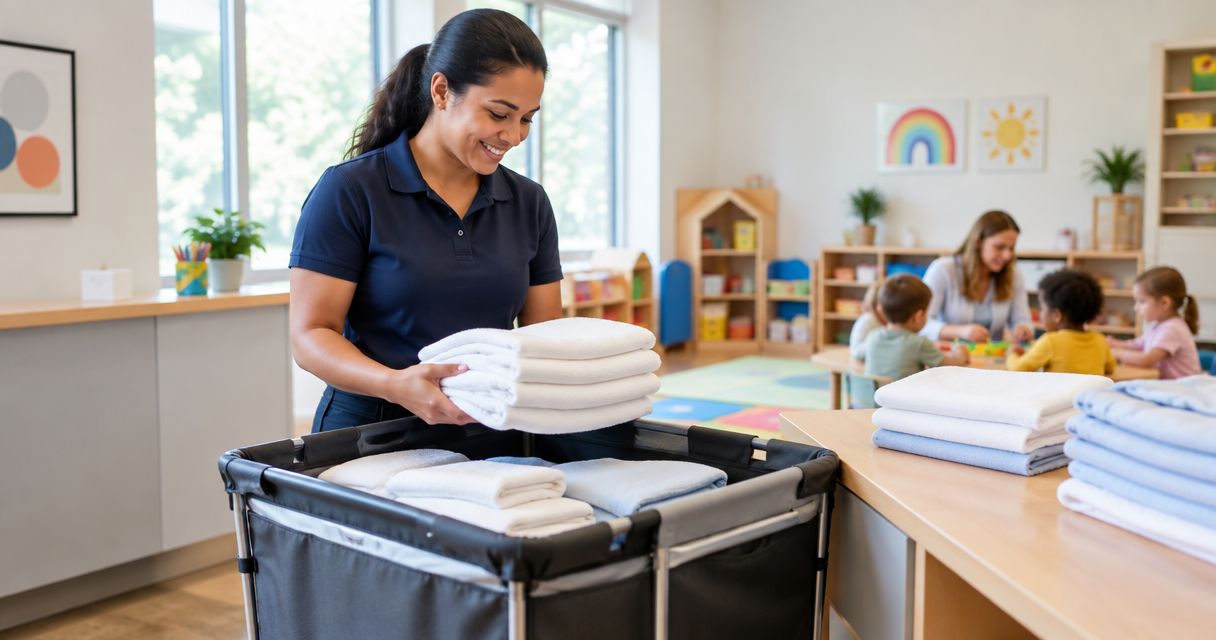
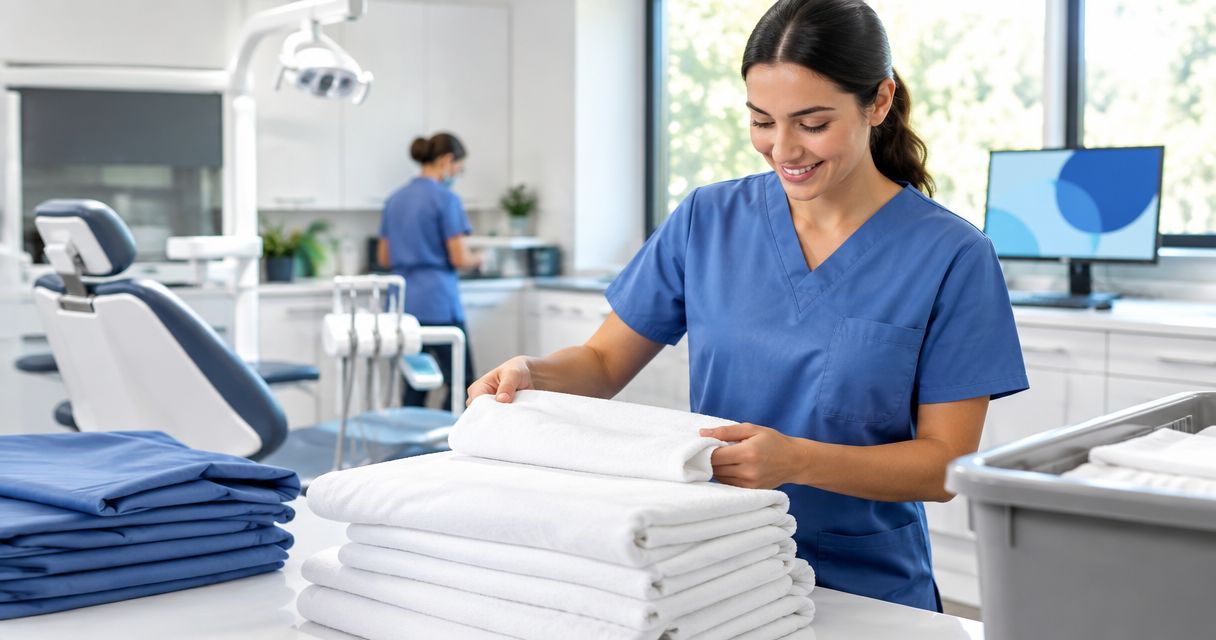
Medical and dental office laundry service is the collection, cleaning, and return of reusable textiles to keep your practice supplied without diverting staff from patient care. This 2026 guide explains how to separate everyday laundry from clinical textiles, choose the right provider, and build a pickup routine that respects your infection-control requirements.
- Choose laundry service for medical and dental offices by textile use and contamination risk, not pickup convenience alone.
- Hampr offers business wash-and-fold; healthcare-specific processing requires separate verification.
- OSHA requires controlled handling of contaminated laundry, including bagging where it was used.
- Keep clean linen storage separate from dirty collection, and plan replacement stock around the confirmed service schedule.
Why laundry service matters for medical and dental offices
A dental office's used protective gown and a break-room tea towel do not belong in the same laundry decision. The question is not just whether something looks dirty. It is what the textile touched, how staff must handle it, and what processing its next use requires.
For your 2026 laundry plan, separate patient-care requirements from ordinary housekeeping. Assign a person to approve textile categories before anybody schedules pickup. That prevents a convenient service arrangement from becoming an unsuitable clinical workflow.
Collection equipment matters, too. The guide to laundry hampers for pickup and delivery covers that practical part of the routine; your infection-control policy must still determine which containers belong in clinical areas.
Choose the laundry process first and the pickup provider second. A delivery app is a scheduling tool, not evidence that a provider meets your healthcare textile requirements.
Build your office laundry routine
Identify what your office sends out
Start with a simple spreadsheet or paper inventory. Walk through reception, treatment rooms, staff areas, and storage, recording each reusable textile and its purpose. Ask the infection-control lead to classify the items; do not leave that judgment to whoever empties the hamper.
Distinguish ordinary office textiles from patient-care linen, protective clothing, and items requiring special processing. A uniform's name alone does not settle the question. Its actual use and contamination determine the handling requirements.
For each category, record who collects it and where it goes. You want an inventory that a new employee can follow without guessing.
- List towels, gowns, uniforms, cleaning cloths, and other reusable textiles separately.
- Record each item's use, care label, and relevant manufacturer instructions.
- Flag blood, other potentially infectious materials, and possible sharps contamination.
- Assign an approved handling and processing route to each category.
Set the handling rules before pickup
Write the collection procedure yourself before asking a vendor to fit it. OSHA's Bloodborne Pathogens Standard, 29 CFR 1910.1030, requires contaminated laundry to be handled as little as possible, with minimum agitation. It must be bagged or containerized where it was used and not sorted or rinsed there.
For covered contaminated laundry, OSHA also specifies labeling or color coding, protective equipment, and containers that prevent soak-through or leakage when wet. Build your 2026 procedure around those requirements and your facility's exposure-control plan. An ordinary household laundry bag is not an automatic substitute.
Keep the instructions short enough to use during a busy shift. Staff need to know where to stop, whom to call, and what never enters the routine pickup pile.
- Bag contaminated laundry at the point of use without shaking it.
- Follow applicable labeling, color-coding, and containment requirements.
- Provide the protective equipment required for the handling task.
- Define a separate response for suspected sharps or incorrect disposal.
Match each textile stream to a provider
The manual starting point is a written vendor questionnaire. Send the same textile inventory to each candidate and ask which categories they accept, how they process them, and what documentation they provide. A general statement about clean laundry does not answer a clinical processing question.
For everyday business laundry, Hampr offers pickup, washing, folding, and delivery in select US cities. That removes those chores from your team's task list, but medical textile acceptance and healthcare-specific processing must be confirmed rather than assumed.
Hampr's laundry service is best for businesses seeking everyday pickup, wash, fold, and delivery—not as a substitute for verified healthcare textile processing. Keep patient-care or contaminated items on the route your infection-control lead approves.
- Ask the provider to accept or reject each textile category explicitly.
- Request details about processing, packaging, transport, and exception handling.
- Verify the service area and pickup arrangements for your office.
- Document which items are excluded from the agreement.
Separate dirty collection from clean storage
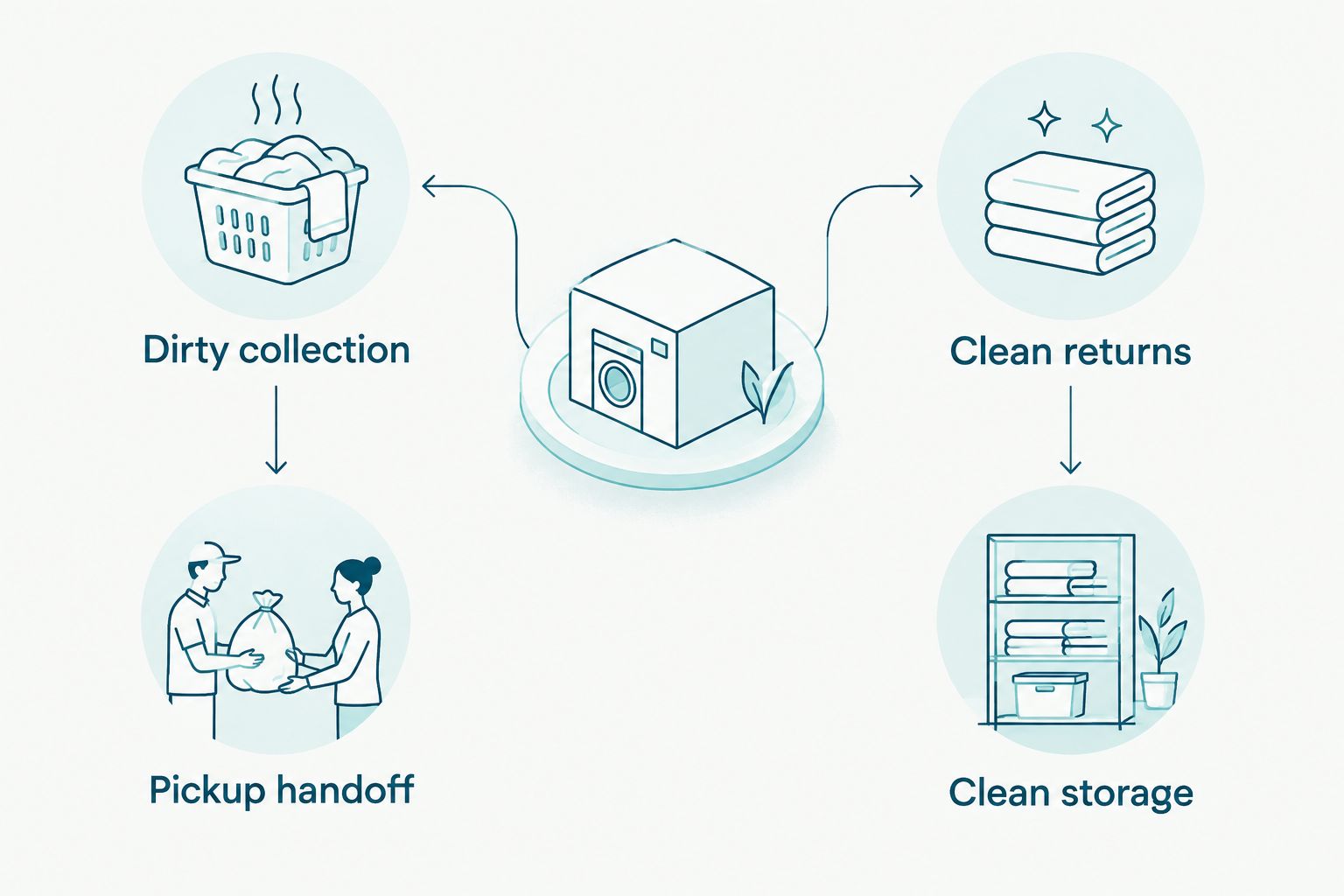
Sketch the route on paper first: where textiles become dirty, where staff contain them, where pickup happens, and where clean items return. Look for crossings. A delivery arriving beside an open dirty-laundry container creates a problem that scheduling alone cannot fix.
Give clean returns their own receiving and storage routine. Staff should inspect packaging and condition before putting items away, following your facility's policy. Keep clean textiles protected from dirt and moisture rather than treating the delivery bag as permanent storage.
A clear handoff also helps your provider. It identifies what they are collecting without inviting staff to reopen or sort bags at the door.
- Designate separate dirty collection and clean storage locations.
- Establish an approved pickup handoff point.
- Inspect clean returns before placing them into circulation.
- Define where damaged, questionable, or incorrectly packaged returns go.
Confirm the processing requirements
Begin with the textile's care instructions and the facility's infection-control requirements. Then ask the provider to explain the process that meets them. You are buying an appropriate cleaning process, not merely a wash cycle with a reassuring name.
CDC environmental infection-control guidance describes a traditional hot-water laundry recommendation of at least 160°F, approximately 71°C, for at least 25 minutes. It also discusses lower-temperature processing with suitable laundry chemicals. Those figures are a published reference point, not a universal recipe or proof that a particular provider qualifies.
In your 2026 review, assess the complete process: washing, chemicals, drying, handling, transport, and storage. Laundering does not establish sterility. Textiles that require sterilization need the appropriate validated process before use.
- Check manufacturer instructions against the proposed wash and dry process.
- Ask how the provider controls its stated processing conditions.
- Verify requirements for patient-care textiles with your infection-control lead.
- Keep laundering and sterilization requirements separate in written instructions.
Plan stock around the confirmed schedule
Count your current textiles before buying replacements or changing providers. Record usage across your actual operating schedule, including the busiest sessions. Then map how long items are out of the office under the provider's confirmed collection and return arrangement.
Do not use an advertised delivery phrase as your inventory plan. Your office needs a defined return arrangement, a way to report a missed handoff, and a backup route. A small trial with approved textile categories lets you check the routine before depending on it.
Keep enough usable stock to cover your documented demand while items are away, plus the reserve your practice decides it needs. There is no single stock quantity that fits every office.
- Count usable stock by textile category, not just total bags.
- Record actual consumption across your operating schedule.
- Document pickup, return, and missed-service procedures.
- Test the arrangement before moving all approved laundry to it.
Review returns and correct problems
Start with a basic receiving log. Record what came back, whether it was suitable for use, and any discrepancy that needs follow-up. The point is not paperwork for its own sake; it is catching a repeated problem before staff quietly work around it.
Assign someone to review exceptions with the provider. Missing items, damaged fabric, questionable cleanliness, or packaging concerns need a defined response. Staff should not return an unacceptable item to circulation simply because the cupboard is running low.
Use those records to adjust the agreement. Changing a detergent preference does not solve a transport problem, and ordering more linen does not solve repeated losses.
- Log rejected, damaged, or missing items by category.
- Hold questionable returns out of use under facility policy.
- Send specific complaints with the relevant collection or return details.
- Review recurring problems and document the corrective action.
Compare laundry options for your office
Choose the 2026 arrangement by textile requirements first, then by staffing and logistics. Each option below has a useful role and a real limitation. The table is a selection framework, not a claim that every provider accepts medical-office laundry.
| Option | Best for | Main advantage | Key limitation |
|---|---|---|---|
| In-house laundry under facility procedures | Practices with suitable equipment, trained staff, and an approved process | Direct control over scheduling and handling | Your practice owns the equipment, training, processing, and maintenance responsibilities |
| Healthcare-focused laundry provider | Patient-care textiles requiring documented healthcare processing | A provider selected specifically for the clinical textile brief | You must verify the actual process, accepted items, and contract terms |
| Hampr business wash-and-fold | Businesses seeking everyday pickup, washing, folding, and delivery | Outsources routine laundry chores | Select-city service; medical textile acceptance and healthcare processing require confirmation |
| Split laundry arrangement | Practices with both everyday and clinically controlled textile streams | Keeps different requirements on distinct routes | Staff must maintain clear separation and manage multiple handoffs |
A split arrangement is best for an office whose textile streams require different processing. It is not automatically simpler: labeling, storage, and staff instructions must make the distinction obvious.
In-house processing is best when your facility can support the required controls. Outsourcing is best when a qualified provider meets the brief and the handoff works reliably. Neither choice removes your responsibility to define what the office needs.
Check your business laundry options
Explore pickup, wash, fold, and delivery, then confirm which office textiles the service accepts.
Common mistakes medical and dental offices make
Treating every towel as ordinary laundry
A towel used in a staff kitchenette and a towel used during patient care need separate assessment. Grouping them by appearance skips the information that determines safe handling. Classify textiles by use and contamination, then apply the approved route.
Taking pickup convenience as clinical proof
An easy booking process says nothing about healthcare textile processing. Ask for answers about your actual inventory before sending it out. If a provider cannot confirm acceptance or the required process, keep those items off that route.
Sending protective clothing home by default
OSHA requires employers to clean, launder, or dispose of required personal protective equipment at no cost to employees. Do not turn required protective clothing into an informal take-home chore. Distinguish PPE from ordinary work clothing in your written policy.
Mixing clean deliveries with dirty staging
The laundry process does not end when a bag reaches your door. Clean items still need protected receiving and storage. Make the return location part of the agreement rather than letting the delivery land wherever there is floor space.
Changing providers without testing the handoff
A new provider changes collection, returns, reporting, and sometimes packaging. Trial approved categories and check the full routine before relying on it. Keep the backup plan active until staff can follow the new arrangement without improvising.
FAQ
What's the best laundry service for a medical or dental office?
The best service is the provider that meets your textile-specific handling and processing requirements. Separate everyday business laundry from patient-care and contaminated textiles before comparing pickup arrangements.
Can Hampr handle laundry for a dental office?
Hampr offers laundry pickup, wash, fold, and delivery for businesses in select US cities. Confirm whether it accepts your specific office textiles; healthcare-specific processing and contaminated laundry acceptance must not be assumed.
Can our staff wash contaminated office laundry at home?
Do not make contaminated laundry or required PPE an informal take-home task. OSHA requires employer responsibility for cleaning required PPE, and contaminated laundry must follow the applicable handling procedures.
Does medical office laundry always need a hot-water wash?
A hot-water wash is not the only processing approach described in CDC guidance. The selected process must meet the textile's instructions and your facility's infection-control requirements, including any suitable chemical controls.
Is washed and folded laundry sterile?
Washed and folded laundry is not established as sterile. Any textile requiring sterilization needs the appropriate validated sterilization process before use.
How much clean linen should our office keep?
Base your stock on measured usage, the confirmed laundry cycle, and your practice's reserve requirement. Count by textile category so a surplus of one item does not hide a shortage of another.
What should we ask before booking office laundry pickup?
Ask which textile categories the provider accepts and how it processes, packages, transports, and returns them. Also confirm the pickup arrangement, rejected-item procedure, and response to missed service.
One last thing
For your 2026 laundry plan, write the exclusion list before the pickup instructions. A clear instruction about what must never enter an everyday laundry bag is more useful than asking staff to use their judgment during a busy clinic session.
Put that list at the collection point and use it during onboarding. Then let the approved laundry routine do its job—without making your team solve the same sorting question every day.