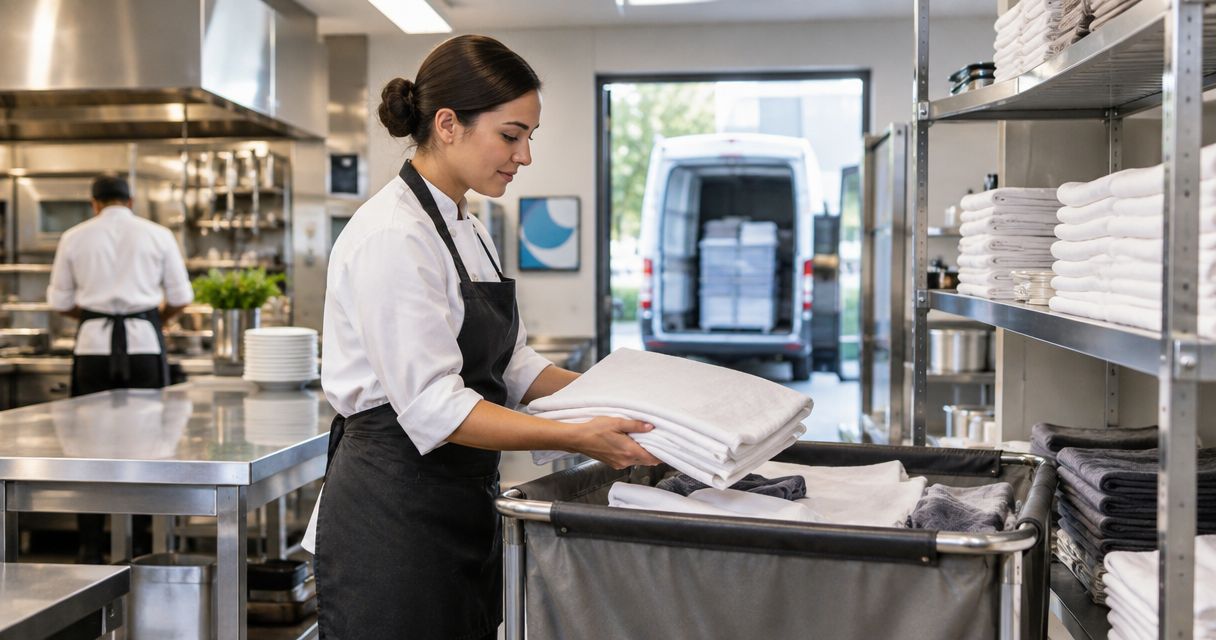
Restaurant and catering laundry service is the collection, cleaning, and return of reusable textiles with the aim of keeping your kitchen, dining room, and events supplied with clean linens. Your plan needs to account for food stains, greasy kitchen cloths, presentation-ready table linens, and catering bags that return after the restaurant has closed.
- Choose laundry service for restaurants and catering by textile requirements, not pickup convenience alone.
- Hampr suits businesses seeking pickup, wash, fold, and delivery in its service cities; confirm your textiles before booking.
- Separate kitchen cloths, table linens, and staff clothing before deciding what to send out.
- Keep enough clean stock to cover the confirmed laundry turnaround and your next service.
Why laundry service matters for restaurants and catering
Laundry is part of service prep, not an afterthought. A clean apron does a different job from a polished tablecloth, and neither belongs in a plan that treats every bag as interchangeable.
Restaurants need textiles ready for the next shift. Caterers also need to track what leaves for an event, what comes back, and what stays packed for the next booking. When those jobs share one laundry pile, counting and sorting become another closing task.
For your 2026 laundry plan, define the finish you need before choosing the collection method. Folded kitchen towels and pressed banquet linens are different requirements. Pickup convenience does not answer whether a provider accepts an item or returns it ready for its intended use.
For stain-specific reading, see the guide to stain removers for food stains. Keep any treatment compatible with the textile’s care label and the receiving provider’s instructions.
Build your restaurant and catering laundry routine
Identify what each textile needs
Start with a simple inventory on paper or in a shared spreadsheet. List what you use, where it gets used, and what condition it must be in when it returns. There is no need to buy a system before you understand the pile.
Group items by their actual job. Aprons need to be clean and wearable; table linens also need the finish your dining room expects. Kitchen cloths need handling suited to their use, including any applicable food-safety requirements. Cleaning requirements should come from care labels, your operating procedures, and the provider’s stated capabilities—not assumptions about what “commercial laundry” includes.
Give each category an acceptance standard. “Clean” is too vague when your event team means “ready to put on a guest table.”
- List kitchen towels, aprons, napkins, tablecloths, and staff clothing separately.
- Record the material and care-label instructions for each category.
- Mark items that require pressing or a particular fold.
- Flag heavily greasy items for a provider acceptance check.
- Separate damaged textiles from items awaiting washing.
Measure your use across real service days
Count clean textiles issued and soiled textiles returned before arranging regular pickups. Use 7 service days as an initial tracking window, then extend it to include a representative catering event. This is a planning exercise, not an industry benchmark.
Record restaurant use and event use separately. A quieter dining-room shift does not describe the laundry from an off-site dinner. Include the items that stay in vehicles or event cases so your count reflects the whole operation.
In your 2026 worksheet, record the date, textile category, quantity issued, quantity returned, and next required use. That gives you something concrete to discuss with a provider instead of guessing from how full the hamper looks.
- Count by textile category rather than by mixed bag.
- Note which shifts or events generated each batch.
- Record linen still waiting to return from an event.
- Identify the next service that needs each category.
- Keep peak-event records separate from ordinary restaurant days.
Match the laundry option to the job
Your manual option is an assigned staff member washing, drying, and finishing textiles under a documented routine. That gives you direct control, but it also makes laundry someone’s shift responsibility. Include sorting and putting items away—not just the machine cycle—when deciding whether that arrangement works.
For items a provider accepts, pickup and delivery removes the collection and return trip from your team’s workload. Hampr offers on-demand pickup, wash, fold, and delivery for households and businesses in select US cities.
Hampr is best for businesses seeking pickup, wash, fold, and delivery in its service cities. Confirm your address and textile requirements before booking; the service description does not establish pressing, linen rental, specialized grease handling, or a restaurant-specific sanitation process.
- Keep suitable in-house washing as an option, not an automatic default.
- Confirm service coverage for your actual pickup address.
- Ask which restaurant textiles the provider accepts.
- Describe the finish required for guest-facing linens.
- Choose separate routes when different textiles need different treatment.
Separate bags by use and destination
Sorting at the source is simpler than asking someone to identify a mystery bag after closing. Use clearly designated collection points for kitchen cloths, dining-room linens, and staff clothing. Follow the provider’s packaging instructions rather than inventing a labeling system the pickup team cannot use.
Keep clean and soiled textile storage separate. Give returned catering textiles a designated receiving point so they do not get mixed with packed event stock. Handle wet or heavily soiled items according to your operating procedures and the provider’s instructions.
The useful distinction is not just “dirty” versus “clean.” You also need to know where each returned item goes. A folded stack is not ready for service if nobody knows which venue or station owns it.
- Use designated containers for kitchen cloths and dining-room linens.
- Remove loose utensils and other non-textile items before packing.
- Identify the event or station associated with each batch.
- Record any unusual soil that the provider needs to assess.
- Assign a clean storage location for each returning category.
Schedule pickups around the next service
Work backward from when textiles must be ready, not from when the bag becomes full. Record the provider’s confirmed collection and return arrangements, then compare them with restaurant shifts, event setup, and building access.
Make the handoff specific. Name who prepares the bags, who handles access, and who receives the return. “The closing team will sort it out” is not a handoff plan. For catering, include the point at which event textiles return to your base before they can enter the laundry routine.
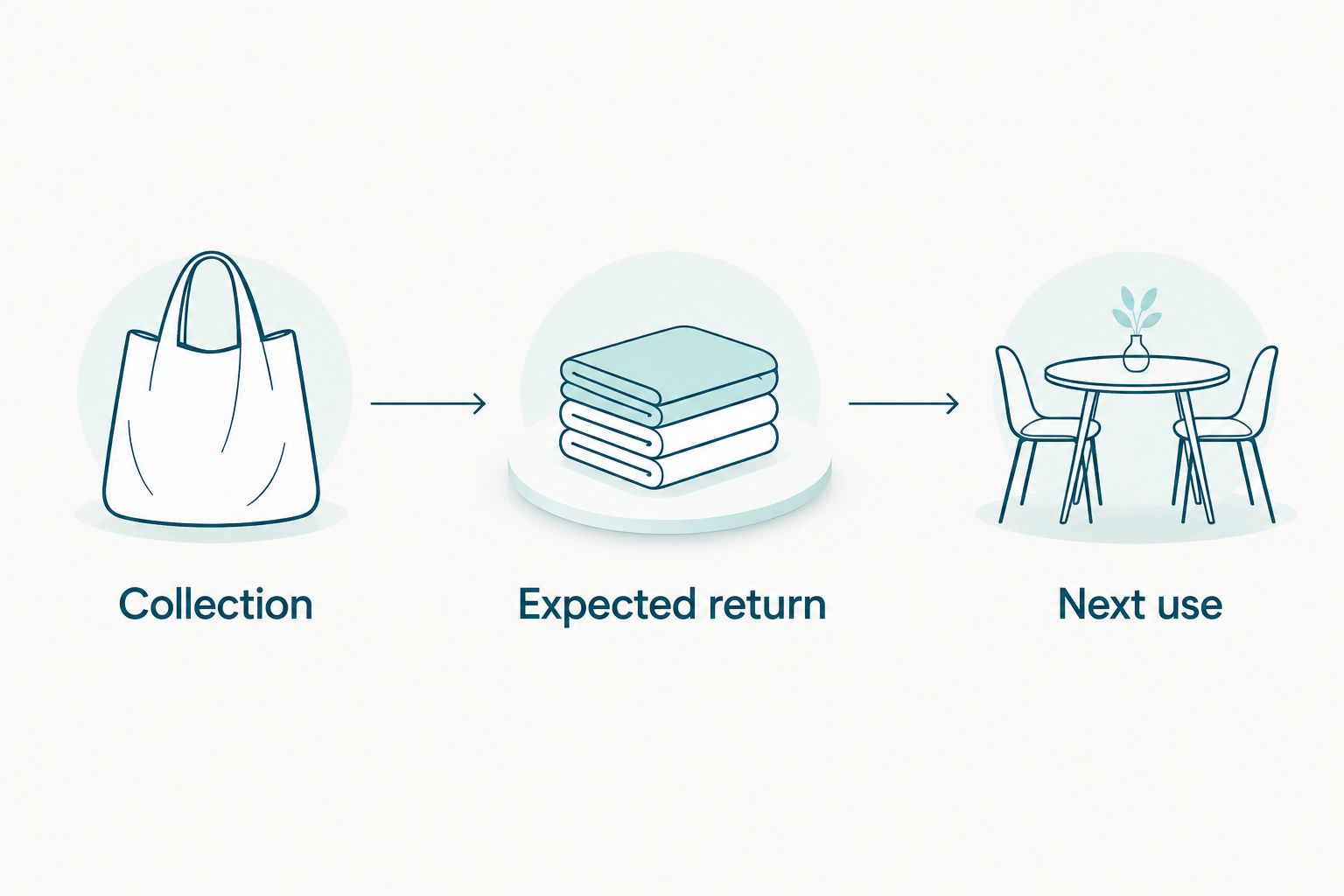
Your 2026 calendar should show collection, expected return, and next use as separate entries. Keep enough clean stock to cover that sequence and an interruption; determine the amount from your measured use rather than a generic linen rule.
- Put the next required use beside each laundry batch.
- Confirm collection and return arrangements directly with the provider.
- Document access instructions for your pickup location.
- Name the person responsible for preparing the handoff.
- Set aside clean reserve stock based on your own usage records.
Check a trial return before expanding
Start with a limited batch of accepted textiles and inspect it before making the arrangement part of your regular routine. Use your written acceptance standards: cleanliness, condition, completeness, and the required finish.
For your 2026 trial, review 3 returned batches before expanding the scope. That is a suggested checking routine, not a claim about service performance. Include different textile categories only after the provider confirms acceptance, and do not use a successful apron batch as proof that banquet linens will meet your presentation standard.
Record problems while the details are fresh. A useful note names the item, the issue, and the service it affected. “Laundry was bad” does not tell either team what to fix.
- Compare returned quantities with your dispatch record.
- Inspect items before putting them into clean storage.
- Check guest-facing linens against your presentation standard.
- Set aside items that do not meet the agreed requirements.
- Record issues and agree on the next action with the provider.
Assign an owner and maintain the routine
Put 1 named owner in charge of the laundry record, with a backup for days off. The owner does not need to handle every bag; they need to keep the process clear when shifts, events, and providers overlap.
Review whether clean stock was ready when required, whether accepted textiles returned in usable condition, and whether staff followed the sorting routine. These are more useful questions than whether pickup itself felt convenient.
Keep your 2026 laundry instructions where the closing and event teams can find them. Update the instructions when you add a textile category, change a service requirement, or discover that a handoff no longer fits your schedule.
- Name the laundry owner and backup in your operating notes.
- Keep provider instructions with the collection checklist.
- Record exceptions rather than relying on shift-to-shift memory.
- Review reserve stock after changes in restaurant or event demand.
- Update the routine whenever accepted items or handoff arrangements change.
Compare your restaurant laundry options
Choose the option that returns textiles in the condition you need. A pickup service, an in-house routine, and a linen rental arrangement solve different parts of the job. Ask for the exact scope before comparing them.
| Option | Best for | Main advantage | Key limitation or check |
|---|---|---|---|
| In-house laundry | Teams that want direct control over owned textiles | You manage sorting, washing, and finishing yourself | Your team must handle the work, equipment, and operating procedures |
| Hampr pickup, wash, fold, and delivery | Businesses seeking an on-demand service in supported cities | Collection and return are part of the stated service | Confirm location and textile acceptance; do not assume pressing or specialized processing |
| Commercial linen laundry | Restaurants with defined finishing or processing requirements | You can select a provider against a written textile specification | Confirm the exact process and finish; the service label alone is not enough |
| Linen rental arrangement | Teams considering supplied linens rather than only washing owned stock | It offers a different way to organize linen supply | Verify ownership, item selection, replacement terms, and return obligations |
| Split laundry routine | Teams whose kitchen textiles and dining linens need different treatment | Each category goes through its appropriate route | Staff must maintain separate records and handoffs |
A split routine is a practical choice when one provider does not cover every requirement. Keep its boundaries obvious: which items stay in-house, which go for wash-and-fold, and which need a different finish. Otherwise, the arrangement adds decisions to every closing shift.
Common mistakes restaurants and caterers make
Treating wash-and-fold as table-ready finishing
Folded does not automatically mean ready for a formal table setting. Define whether your napkins and tablecloths need pressing, then confirm who supplies that finish. Do not discover the gap during event setup.
Mixing kitchen cloths with guest-facing linens
Kitchen cloths and dining-room textiles have different uses and handling requirements. Keep their collection routes distinct and ask about acceptance before sending a mixed batch. A single convenient bag is not a substitute for a textile plan.
Counting only what comes back that evening
Catering textiles can remain at an event site, in transport, or in packed equipment cases. Include those items in your inventory record so an apparently small laundry pile does not hide missing stock. Name who checks the event return.
Scheduling from bag fullness instead of service needs
A bag can be ready for pickup while your next event still lacks clean napkins. Tie collection to confirmed return arrangements and the next required use. Convenience belongs in the plan, but service readiness comes first.
Leaving receiving checks to whoever opens the bag
Without an assigned check, an incomplete or unsuitable return can reach storage unnoticed. Use the same acceptance standard every time and keep problem items separate. That makes the next action clear without turning laundry into another meeting.
FAQ
What's the best laundry service for restaurants and catering?
The best laundry service is the one that accepts your textiles and returns them with the finish your operation requires. Compare collection arrangements, item acceptance, processing requirements, and return timing before choosing.
Can I use Hampr for my restaurant laundry?
Hampr offers pickup, wash, fold, and delivery for businesses in select US cities. Confirm coverage for your address and acceptance of your specific restaurant textiles before booking.
Is laundry pickup better than washing restaurant linens in-house?
Pickup is the better fit when you want collection and return handled outside your team and the provider meets your textile requirements. In-house washing gives you direct control but leaves sorting, cleaning, finishing, and storage with your staff.
Can I send kitchen towels and tablecloths in the same bag?
Keep kitchen towels and tablecloths in separate collection categories and follow the provider's packaging instructions. Their different uses and soil types need an explicit acceptance and handling plan.
Does wash-and-fold include pressing restaurant tablecloths?
Do not assume wash-and-fold includes pressing. Ask the provider to confirm the finish for tablecloths and napkins before sending items that need to be table-ready.
How often should a catering business schedule laundry pickup?
Schedule pickup around confirmed return arrangements and the next event that needs the textiles. Track event use and returning stock first, then set a routine that covers your actual calendar.
How much clean linen should a restaurant keep in reserve?
Keep enough clean linen to cover measured use during the confirmed laundry turnaround plus an interruption. Calculate the reserve separately for kitchen textiles, dining linens, and event stock rather than using one blanket quantity.
One last thing
Count the clean shelf, not just the dirty hamper. The hamper tells you what needs washing; the shelf tells you whether the next service is ready. Before changing your laundry arrangement, write down the textiles your next shift or event needs and check that they are actually usable—not simply back in the building.