A laundry service for cleaning companies is outsourced washing, drying, folding, and transport of reusable textiles with the aim of keeping crews supplied for booked jobs. Unlike household laundry, your cleaning cloths, mop heads, uniforms, and client linens need separate handling decisions—not one big bag and crossed fingers.
- Choose a laundry service for cleaning companies around accepted textiles, pickup logistics, and your next crew departure.
- Hampr provides business laundry pickup, wash, fold, and delivery in select US cities; confirm acceptance of cleaning textiles.
- Separate cleaning cloths, uniforms, and client linens before choosing a wash-and-fold routine.
- Compare outsourcing with in-house washing using staff time, transport, handling requirements, and ready-to-use inventory.
Why laundry service matters for cleaning companies
Your cleaning schedule depends on supplies being ready when crews leave. Washing is only part of that job: someone also sorts used textiles, transfers loads, dries them, checks the results, and gets everything back onto the right shelf.
For your 2026 operating plan, treat laundry as part of dispatch rather than an after-hours chore. A finished load is not useful if it arrives after the crew has gone.
Hampr provides on-demand laundry pickup, wash, fold, and delivery for households and businesses in select US cities. Hampr is a fit for cleaning companies seeking business laundry pickup and delivery, subject to local coverage and textile acceptance. Confirm those details before sending cleaning supplies; a business laundry service is not automatically a specialist processor for every cleaning residue.
The practical question is not simply whether outsourcing removes washing from your day. It is whether the whole handoff leaves your team with clean, usable supplies when needed.
How to build a laundry routine that supports your crews
1. Audit what your crews actually use
Start with a shared spreadsheet or paper log. Track 7 working days as a planning exercise, recording what leaves with each crew, what comes back used, and what sits waiting for a wash. This is your baseline—not a promised industry benchmark.
Keep client-owned items separate in the log. A rental property's sheets and your team's floor cloths have different owners and handling needs, even when they arrive in the same vehicle.
Record laundry work as well as laundry volume. Include the interrupted office task, the supply run, and the trip back to move a load. Your 2026 comparison should reflect the complete task, not just time beside the washer.
- List textile types and their owners.
- Count items using consistent units, such as cloths or mop heads.
- Record staff handling time in minutes.
- Note the next job that needs each batch.
- Flag items with special care instructions.
2. Separate textiles by care and contamination
Read the care labels and textile manufacturers' instructions before deciding what belongs together. Do not choose one wash method for every item just because everything came from a cleaning job.
Use 3 initial sorting groups: cleaning textiles, uniforms, and client linens. Then divide those groups further wherever care instructions, cleaning products, or site requirements demand it. These are organizing categories, not permission to wash everything within a category together.
Keep unknown or potentially hazardous residues out of ordinary wash-and-fold orders. Follow the cleaning product's safety data sheet and the laundry provider's acceptance instructions. Do not improvise treatment or mix chemicals to rescue a stained cloth.
- Identify microfiber, cotton, and other labeled materials.
- Separate client-owned linens from company supplies.
- Record cleaning products used on reusable cloths.
- Isolate items requiring specialist handling.
- Ask about items with heavy soil or chemical residues.
3. Confirm the provider's scope before booking
Write your requirements in an email or simple checklist, then ask providers to confirm them. Describe the actual load: reusable bathroom cloths, general dusting cloths, mop heads, uniforms, or linens. Calling everything “towels” hides the details that determine acceptance.
Hampr's laundry pickup and delivery service offers an outsourcing option for businesses. The fit depends on your location and the items you need processed; do not assume specialist cleaning-textile treatment, a particular return window, or commercial-volume arrangements.
For larger batches, use the guide to business laundry pickup for bulk orders to frame your questions. Get answers for your order rather than treating a general service description as confirmation.
- Describe each textile and its usual soil.
- Confirm service coverage for the handoff address.
- Ask which items the provider excludes.
- Confirm how to submit care instructions.
- Ask how discrepancies and damaged items are handled.
4. Work backward from crew departure
Put the next required use on your calendar first. Then agree on a return arrangement that supports it, followed by a pickup arrangement that the provider can actually meet. A calendar reminder organizes your team; it does not create a service commitment.
Choose one named person to manage the handoff and a backup for absences. For your 2026 routine, make responsibility visible so that a bag does not wait by the door while everyone assumes someone else booked it.
Keep pickup and return instructions separate. The place used for outgoing laundry is not necessarily suitable for clean supplies, especially where used equipment is stored nearby.
- Record the next crew departure.
- Confirm pickup and return arrangements directly.
- Assign a handoff owner and backup.
- Write clear access instructions.
- Keep clean returns away from used supplies.
5. Pack and label each batch consistently
Use a simple handoff record before buying extra tools. A label and matching log entry should tell your staff what the batch contains, who owns it, and where it belongs when returned. Ask the provider which packaging and labeling methods it accepts.
Keep sensitive customer information out of visible labels. An internal job code can identify client linens without displaying an address or access details.
The handoff follows a repeatable sequence: Sort textiles, Record batch, Confirm pickup, Check return, Restock crews. Follow that sequence even during a busy week; skipping the record makes a later mismatch harder to resolve.
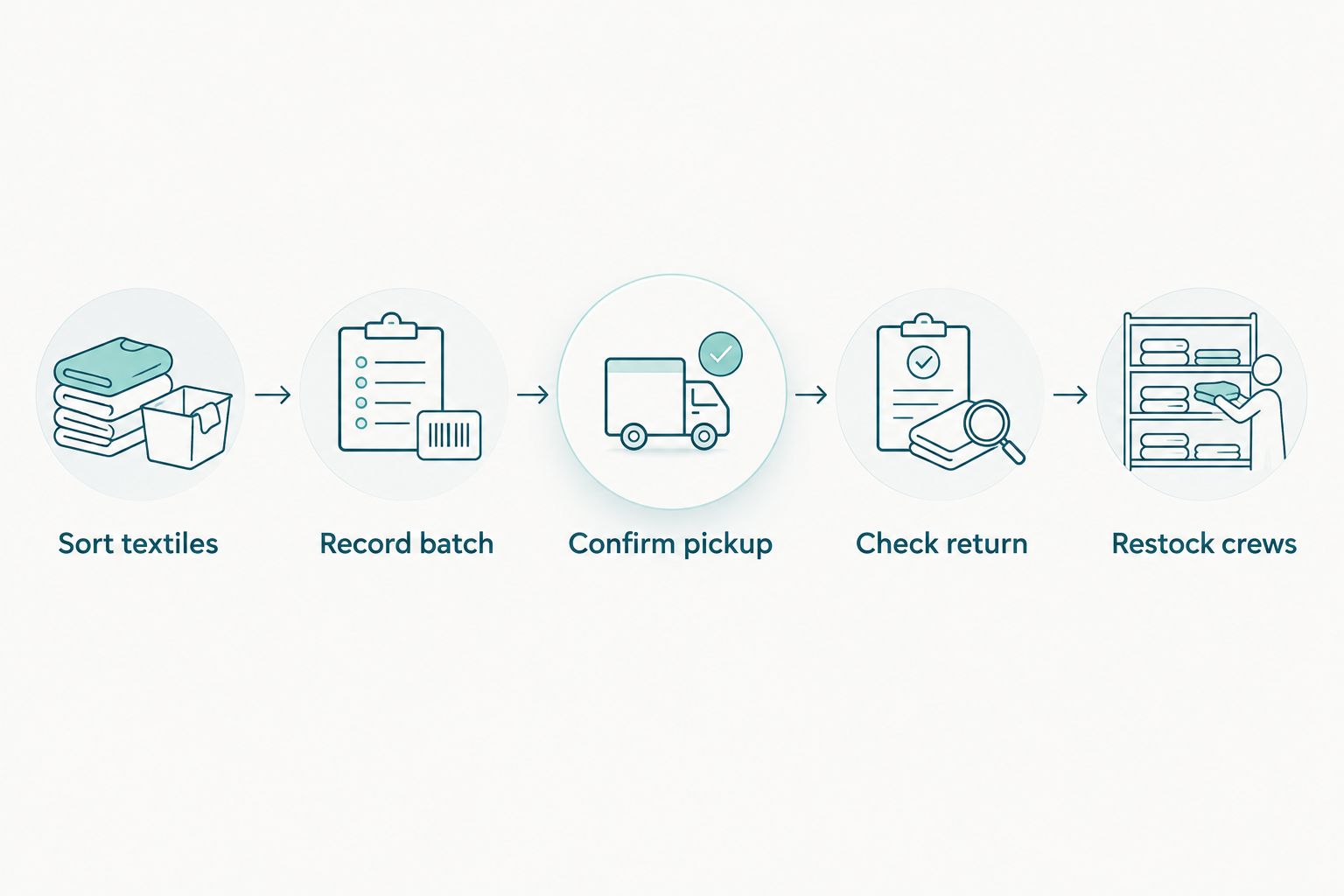
A consistent batch record gives both your dispatcher and the person receiving clean laundry the same reference. Keep it short enough that staff will complete it during a real shift.
- Assign a batch identifier.
- Record contents and ownership.
- Include accepted care instructions.
- Use the provider's agreed packaging method.
- Record who handed the batch over.
6. Test the routine before moving every load
Run a limited trial with accepted, non-specialist items before relying on an outside provider for all supplies. Keep your existing washing arrangement available during the trial rather than switching everything at once.
Review 2 pickup cycles as an initial process check. That is a suggested trial length, not proof of long-term performance. Include a normal crew departure in the test so you can judge whether the return fits your working day.
Check more than appearance. Staff should inspect returned items against the agreed instructions and report issues before those items go back into cleaning kits. Record specific problems rather than a vague “laundry wasn't right.”
- Compare the return with the batch record.
- Inspect items for visible soil and damage.
- Check that returned textiles are dry.
- Confirm that sorting supports your crew kits.
- Record whether supplies arrived before their required use.
7. Review the full workload and keep a backup
Compare in-house washing and outsourcing using the same workload. Record staff handling minutes, trips, consumables, equipment upkeep, and the provider's current terms. Do not compare one option's entire process with only the other's washing step.
Use your 2026 trial notes to decide what to outsource, what to retain, and what requires a specialist. A mixed arrangement is a valid result. You do not need to put every textile into the same system.
Keep enough ready-to-use inventory to cover the gap between dispatch and the next confirmed return. Calculate that buffer from your own usage and schedule, then name a fallback for missed handoffs or rejected items.
- Review handling time and supply use.
- Track rewash requests and missing items.
- Identify textiles that should stay in-house.
- Set a clean-inventory reorder point.
- Document the backup washing arrangement.
Compare laundry options for your cleaning company
Choose an option by the work it removes and the control it leaves with your team. No single arrangement wins for every cloth, site, and route. These “best for” labels describe operational fit, not tested performance rankings.
| Option | Best for | Main advantage | Key limitation |
|---|---|---|---|
| In-house washing | Teams that need direct control over every batch | You control handling and the washing schedule | Staff still manage sorting, equipment, drying, and restocking |
| Self-service laundromat | Teams that need washing capacity without installing equipment | Your team retains hands-on oversight | Staff must transport loads and manage the visit |
| Hampr pickup, wash, fold, and delivery | Businesses seeking to outsource routine laundry handling | Combines pickup, processing, and return delivery | Serves select US cities; confirm cleaning-textile acceptance and order arrangements |
| Specialist commercial laundry | Teams whose documented processing requirements exceed ordinary wash-and-fold | Lets you seek a provider against a specific handling specification | You must verify that the provider meets the required process |
For ordinary accepted laundry, pickup and delivery removes the need to transport loads yourself. It still requires sorting, instructions, receiving, and restocking on your side. Keep those responsibilities in your operating plan rather than expecting the laundry bag to manage itself.
For textiles with a required decontamination process, choose against that requirement first. Convenience is a secondary filter, not a substitute for documented handling.
Common mistakes cleaning companies make
Treating every used cloth as ordinary laundry
A dusting cloth and a cloth carrying an unknown cleaning residue need different decisions. Record what your crews use, consult product instructions, and confirm acceptance before packing a batch. A pickup booking does not establish that an item is suitable for processing.
Scheduling around pickup instead of the next job
Getting dirty laundry out of the office feels like progress. Your crews need the clean return. Work backward from dispatch and keep a separate buffer for the period when supplies are away.
Mixing client linens with company cleaning supplies
Mixed ownership makes returns harder to reconcile, even before care requirements enter the picture. Separate the batches and keep a simple record of which client owns which items. Do not make your receiving staff identify sheets from memory.
Counting washed items as ready-to-use inventory
Returned laundry still needs a receiving check and a storage location. An unopened delivery bag is not a restocked crew kit. Assign someone to inspect, record, and shelve the return before counting it as ready for dispatch.
Skipping the backup because the trial went well
A successful trial checks your initial routine; it does not remove the need for contingency planning. Keep an alternative washing arrangement and a clear response for rejected items. Your next cleaning appointment should not depend on one unexamined handoff.
FAQ
What's the best laundry service for cleaning companies?
The best fit accepts your exact textiles and returns them in time for crew dispatch. Hampr provides business laundry pickup, wash, fold, and delivery in select US cities; confirm local coverage, item acceptance, and order arrangements before choosing it.
Can I send microfiber cleaning cloths to a laundry pickup service?
Send microfiber cleaning cloths only after confirming that the provider accepts them and can follow their care instructions. Identify the cleaning products used on the cloths, and do not assume ordinary wash-and-fold includes specialist processing.
Can cleaning cloths and client sheets go in the same laundry bag?
Keep cleaning cloths and client sheets in separately identified batches. Different ownership, soil, and care requirements need clear instructions, and the provider should confirm its accepted packing method.
How often should a cleaning company schedule laundry pickup?
Schedule pickup around actual textile use and the next required clean return. Track your crew usage first, then confirm arrangements that leave enough ready-to-use supplies for booked jobs.
Is laundry pickup better than washing cleaning supplies in-house?
Laundry pickup fits teams that want to outsource accepted laundry handling, while in-house washing keeps direct control with staff. Compare the full workload, including transport, sorting, receiving, and restocking, before deciding.
Does ordinary wash-and-fold disinfect cleaning textiles?
Do not treat ordinary wash-and-fold as a verified disinfection service. If a job requires a specific decontamination process, obtain confirmation that the provider meets that requirement before sending the textiles.
How should I test a laundry service before switching?
Test a limited batch of accepted items while retaining your current washing arrangement. Check the return against your batch record, inspect the textiles, and confirm that the handoff supports the next crew departure.
One last thing
Your laundry process ends when the next crew has a complete kit—not when the washing finishes. For your 2026 routine, put receiving and restocking on the schedule with a named owner. That small assignment closes the gap between a clean delivery and supplies your team can actually take to a job.