Instead of remembering laundry day from scratch, use a calendar reminder to prompt your booking and bag preparation, then confirm the pickup through Hampr. To connect Hampr to Google Assistant for pickups, keep the boundary clear: this 2026 workflow organizes your reminders; it does not turn a voice command into a confirmed laundry order.
- To connect hampr to google assistant for pickups, use reminders as prompts—not proof of a booked pickup.
- Hampr handles laundry pickup, washing, folding, and delivery; your calendar handles the reminder.
- Confirm the pickup through the service before adding its details to Google Calendar.
- Test voice access on your current device, and keep calendar notifications as your fallback.
Why this matters
Laundry has two separate jobs: arranging the service and remembering what you need to do before it arrives. Putting a reminder on your calendar solves the second job. It does not solve the first.
Hampr is best for households and businesses that want laundry pickup, washing, folding, and delivery rather than doing the laundry themselves. For the reminder workflow, its role is the service you book—not a calendar action you assume has placed an order.
That distinction matters when you speak to an assistant. A response confirming a reminder means the reminder exists. It is not evidence that a laundry provider received your request, accepted your instructions, or scheduled a pickup.
The practical approach in 2026 is simple: book, record, prepare. Keep the service confirmation as your source of truth and let the calendar do the remembering. No mysterious connection required, and no laundry bag waiting outside because a reminder sounded like a reservation.
Before you start
- Service access and a confirmed plan: Have access to your laundry service and confirm that it serves your address. Keep the pickup details where you can refer to them during setup.
- Calendar access and your current device: Have a Google account, access to Google Calendar, and permission to receive calendar notifications. If you want voice access, test what the assistant on your device actually supports before relying on it.
- The gotcha: separate records: A calendar event and a service booking are separate records. Changing one does not establish that the other changed; update both whenever you move or cancel a pickup.
Use the Google Calendar web interface for the steps below. It gives you a visible record to inspect before adding voice access. Mobile layouts differ, so do not hunt for a matching button if your screen looks different; open the web calendar instead.
Have your pickup instructions nearby, too. A calendar note is useful for your own preparation, but it is not a way to send instructions to the person collecting your laundry.
Choose your reminder workflow
Pick the workflow by what you need to remember—not by which one sounds most automatic.
| Workflow | Best for | What it does | Advantage | Limitation |
|---|---|---|---|---|
| Calendar-first reminder | Anyone who wants a visible setup | Records booking and preparation tasks in Google Calendar | You can inspect the date, time, and notification | You still arrange the pickup separately |
| Voice-assisted reminder | People whose current assistant supports calendar actions | Uses speech for supported reminder or calendar actions | Useful when your hands are busy | Device support must be tested; voice acknowledgement is not a booking |
| Confirmed-pickup event | People with an arranged pickup | Records the details supplied by the service | Keeps your calendar tied to an actual booking | Changes require checking the service record and calendar separately |
Start with the calendar-first reminder. It is the easiest version to verify because the date, event title, and alert are visible. Add voice access only after that foundation works.
For a repeating schedule, the Google Calendar guide for recurring pickups is the adjacent workflow to review. Keep the same distinction there: repeating a calendar event does not repeat a service order.
Pickup confirmation
The first configuration unit is not a device setting. It is the actual pickup arrangement.
- Arrange your pickup through Hampr and retain the confirmation supplied by the service.
- Read the confirmed date, any stated pickup window, and the instructions relevant to your order. Do not replace a stated window with a precise arrival time of your own.
- Decide what your calendar needs to prompt: arranging the next pickup, preparing the laundry, or remembering an already-confirmed collection.
- Give an unbooked task an unmistakable name, such as Arrange laundry pickup. Reserve Confirmed laundry pickup for an arrangement you have actually confirmed.
Expected result: You know whether the calendar item represents an action you still need to take or a pickup already arranged.
That naming rule is small but useful. A busy household member should be able to read the event and know whether someone still needs to book. The calendar should not make an unfinished task look finished.
For a business, choose one person to own the booking. Other staff can help prepare the laundry, but the person responsible for the service request should also check changes and cancellations.
Calendar event
Create a visible event before testing anything by voice. This is the record you will use to check whether later commands worked.
- Open Google Calendar on the web and select Create, then Event.
- Enter a clear title in Add title. Use Arrange laundry pickup for a booking prompt or Prepare laundry bag for a preparation task.
- Set the date and time to match the action you need to take. If the event records a confirmed pickup, use the details supplied by the service.
- Use Add description for preparation notes. For example, write Check pockets, gather washable items, and follow the service’s packing instructions.
- Check which calendar will hold the event, then select Save.
Expected result: The event appears on the intended calendar with a title that accurately describes its status.
Avoid copying sensitive access information into a calendar shared with people who do not need it. The event can say Check pickup instructions without containing door codes or other private details.
For a 2026 household routine, keep preparation and collection separate if they happen at different times. Your bag-preparation event tells you to act; the pickup event records the service arrangement. That keeps a reminder from pretending to be a delivery update.
Notification settings
Set the alert for the action, not simply for the moment you would like the laundry to disappear.
- Open your calendar event and select Edit event.
- Select Add notification and choose a lead time that gives you room to complete the task.
- For a preparation reminder, place the event when you intend to gather and pack the laundry. For a booking reminder, place it when you can actually arrange the service.
- Select Save, then reopen the event to inspect the notification setting.
- Create a temporary test event and check that its notification reaches the device you plan to use. Delete the test after checking it.
Expected result: You have checked an actual calendar alert, rather than assuming that saving an event enables every device notification.
Here is an example, not a pickup promise: schedule bag preparation for 6:00 p.m., use a 30-minute advance notification, and set aside 10 minutes to gather the laundry. Replace those example timings with a routine that fits your household.
The key is to allow time for action. An alert that appears when you are already leaving home is a reminder with unfortunate timing—not a useful laundry plan.
Voice-access check
Voice access is an optional input method. The calendar workflow should still work without it.
- On the device you intend to use, check whether its current assistant supports the calendar action you want: creating an event, reading an event, or setting a reminder.
- If supported, make a harmless test request with a distinctive title and an explicit date and time. Use a phrase such as Create a calendar event called Laundry setup test tomorrow at six p.m. as a test request, not a guaranteed command.
- Open Google Calendar and inspect the result. Check the title, date, time, and account; do not rely only on the spoken response.
- If the event is correct, delete the test. If it is missing or incorrect, use the calendar interface for your laundry reminders.
- Keep pickup booking outside this test. No calendar test should be treated as permission to place, move, or cancel an order.
Expected result: You know whether voice access works on your device and have a calendar-based fallback if it does not.
In 2026, use the interface actually present on your device. If its assistant name or supported actions differ from a guide you have seen, follow the current on-device help rather than searching for an old setting.
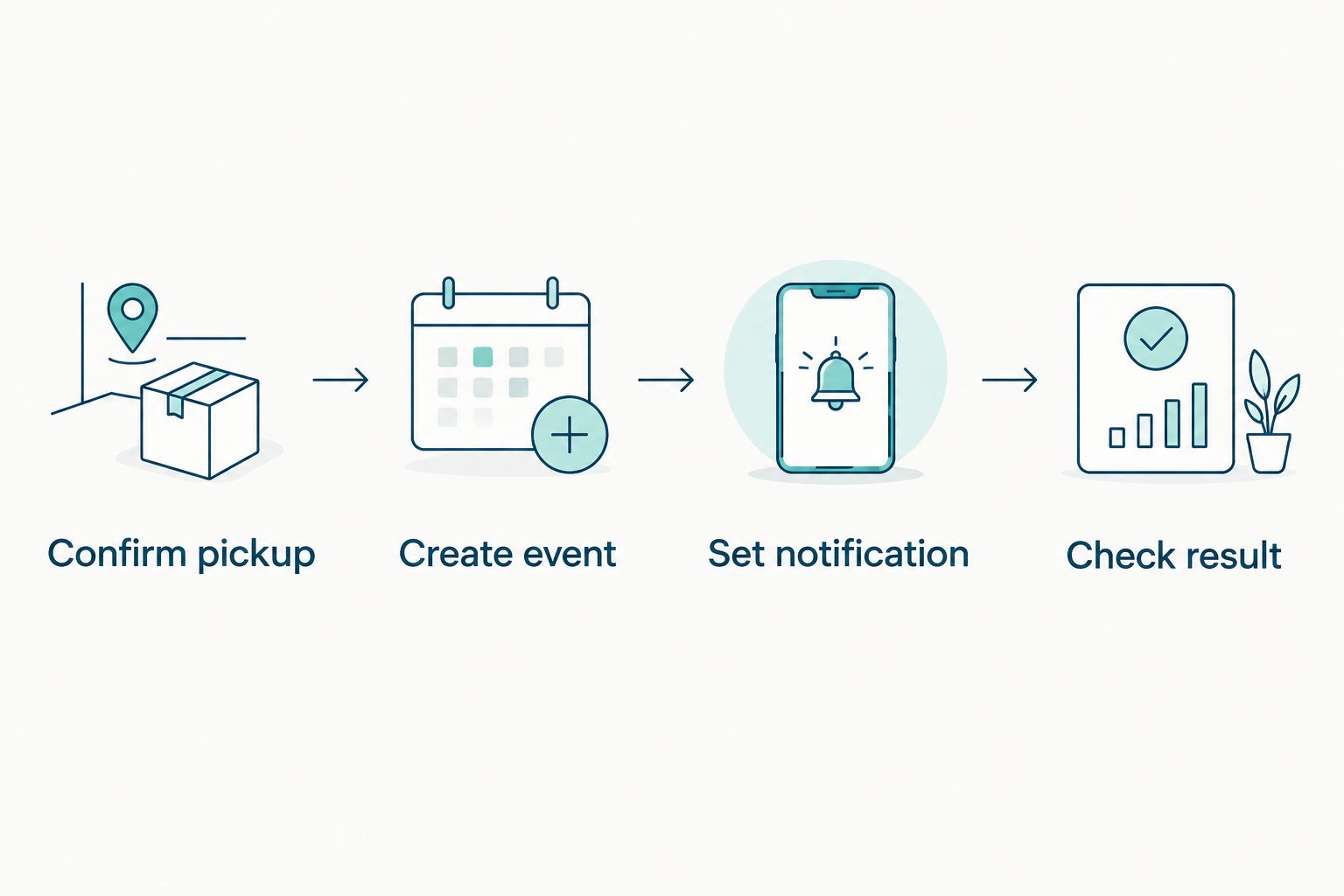
The whole sequence is Confirm pickup, Create event, Set notification, and Check result. Each stage has its own check; none depends on a voice response standing in for a service confirmation.
Update reminders when a pickup changes
The useful second workflow is rescheduling. It is a manual update, not an automatic connection between two services.
Start with the service record whenever a confirmed pickup changes. Check the revised details there before adjusting the calendar. Moving a calendar block first can leave you with a tidy schedule and an unchanged order.
- Confirm the revised pickup arrangement through the service.
- Open the matching calendar event and select Edit event.
- Update the date, time, and description to match the revised confirmation.
- Check the preparation reminder separately. A moved pickup can require a moved bag-preparation task.
- Select Save and inspect the result on the device you use for alerts.
Expected result: The calendar reflects the confirmed change, and the preparation reminder still makes sense.
For a recurring preparation event, open Does not repeat during setup and choose the repeat pattern that fits your routine. Treat each occurrence as a preparation prompt. It does not establish a recurring service booking.
If you cancel a pickup, remove or rename its calendar event after checking the cancellation through the service. Leaving a cancelled collection on a shared calendar invites someone else to prepare a bag unnecessarily.
Troubleshooting
The assistant responds, but no calendar event appears
Check the calendar account, date, and event title. A reminder stored elsewhere is not the same as an event on the calendar you inspected. If you cannot find the intended record, create it directly in Google Calendar and verify it there.
The event exists, but no alert arrives
Reopen the event and inspect its notification setting. Then check device notification permissions and any settings that silence alerts. Repeat the temporary-event test before depending on the reminder for a real pickup.
The voice request uses the wrong day or time
Replace relative wording with an explicit date and time, then inspect the saved result. Check the calendar’s time zone as well. Correct the visible event; a spoken correction is not enough until you verify the record.
You changed the calendar, but the pickup did not change
Update the service arrangement separately and check its confirmation. This workflow does not synchronize bookings. Once the service change is confirmed, bring the calendar back into line with it.
Two reminders tell you different things
Keep one event for each distinct action and remove accidental duplicates. Use status-specific titles: Arrange laundry pickup is unfinished work; Confirmed laundry pickup records an arrangement. Those titles prevent two alerts from telling two different stories.
Customize your workflow
Once the basic reminder works, adapt it to your actual laundry pile.
- Households: Separate the booking task from bag preparation if different people handle them.
- Apartment residents: Add a preparation note to check the service’s pickup instructions before taking laundry to a collection location.
- Businesses: Assign a booking owner and a preparation owner. Record the responsibilities in the event description without treating the calendar as a service messaging channel.
- Changing schedules: Keep booking prompts flexible, then add pickup details only after confirmation.
For your 2026 routine, start with one useful reminder and expand only when something gets missed. A calendar full of laundry alerts is still a chore if nobody knows which alert needs action.
FAQ
Can I connect Hampr to Google Assistant for pickups?
Use Google Assistant for supported reminder or calendar actions, and arrange the pickup separately through Hampr. This guide does not establish a direct booking integration; a reminder is not a confirmed order.
Does saying a laundry pickup command book the service?
A spoken reminder or calendar command is not proof of a booked pickup. Check the service confirmation before treating the pickup as arranged.
What if my device no longer has Google Assistant?
Use Google Calendar directly and test any calendar actions supported by your current assistant. The reminder workflow does not require a particular assistant name.
Can I make my laundry reminder repeat every week?
Yes, you can set a repeating event in Google Calendar. Each occurrence is a reminder, not evidence that a recurring pickup has been booked.
Will changing the calendar event reschedule my pickup?
No, this manual reminder workflow does not reschedule the service. Confirm the change through the service, then update the calendar event and preparation reminder.
Why did my laundry reminder fail to notify me?
Check the event notification, device permissions, and settings that silence alerts. Use a temporary test event to verify that the alert reaches your device.
Is a calendar-first setup better than a voice-first setup?
A calendar-first setup is better for inspecting the saved date, time, and notification before relying on them. Voice access is an optional convenience once you have tested it on your device.
One last thing
Name the unfinished action, not the outcome you hope for. Arrange laundry pickup tells you something still needs doing. Laundry pickup can look like a confirmed appointment even when you have only created a reminder.
That small wording change makes the workflow easier to trust. Let the service confirmation prove the booking; let the calendar remind you to do your part.