Yes—laundry pickup services can fold clothes a specific way when the provider agrees to your instructions before pickup. A wash-and-fold booking alone does not confirm a particular folding method, drawer size, or packing arrangement; explain what you want and get confirmation before sending your clothes.
- Can laundry pickup services fold clothes a specific way? Yes, when the provider confirms your folding instructions before pickup.
- Request a finished shape, garment grouping, and packing order—not just a folding style name.
- Hampr provides laundry pickup, washing, folding, and delivery; confirm custom folding separately.
- For drawer-ready laundry, explain where clothes will go and which preferences matter most.
Why this matters
Clean clothes still leave you with a chore if you need to unfold and refold everything before putting it away. Your folding request should describe the result you need: shirts that stand upright in a drawer, towels that fit a shelf, or separate stacks for different people.
The useful question in 2026 is not just whether a service folds laundry. It is whether the service can follow your particular instructions. Get that settled before pickup, rather than discovering a mismatch beside a mountain of clean T-shirts.
Hampr provides on-demand laundry pickup, washing, folding, and delivery for households and businesses in select US cities. Custom folding is a separate detail to confirm, not something to infer from the words wash and fold.
Can laundry pickup services fold clothes a specific way?
Yes, provided the service accepts your requested method. Treat custom folding as an agreement about the finished laundry, not an automatic feature of every pickup order.
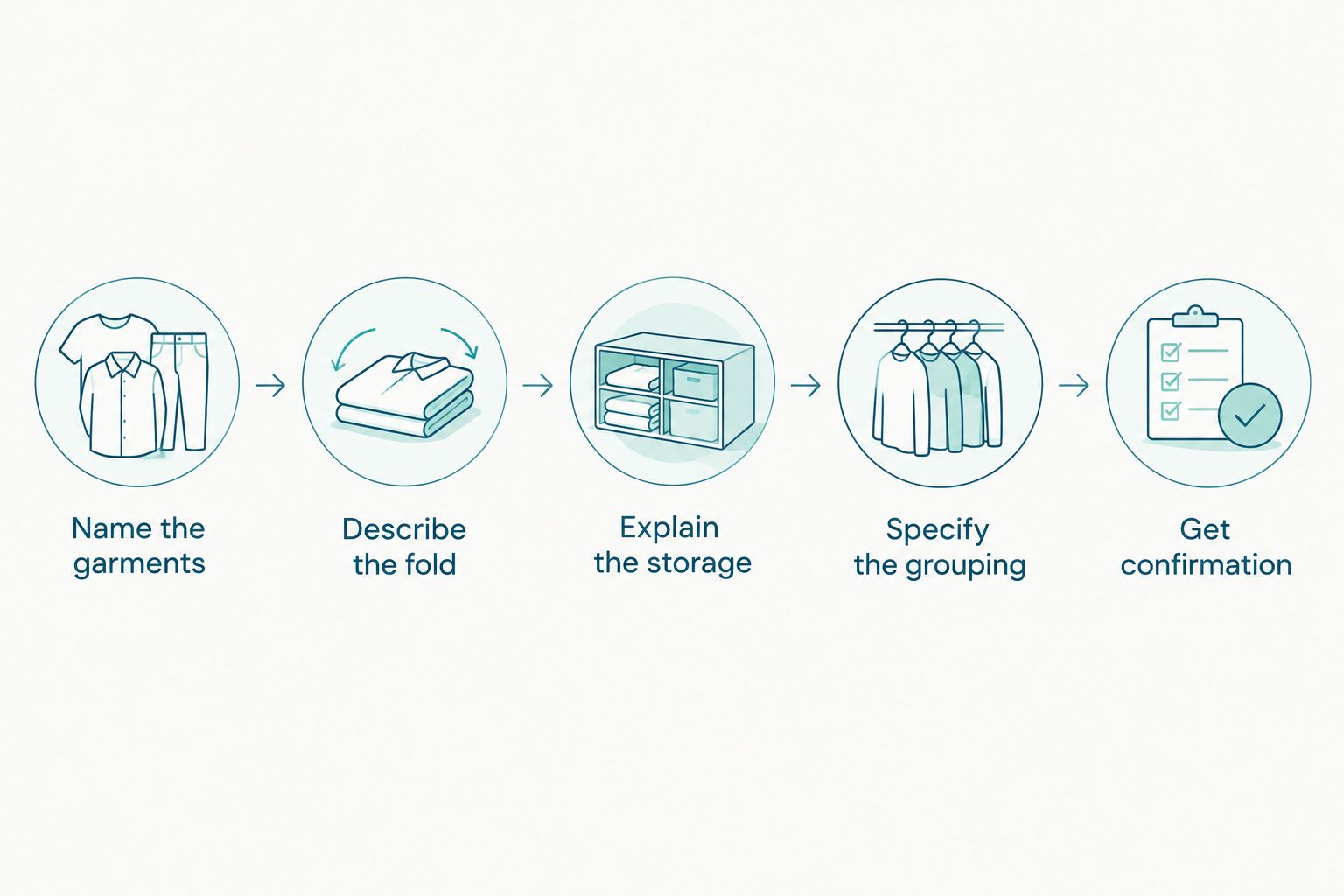
Use these 5 steps to make the request clear:
- Name the garments. Say whether the instructions apply to T-shirts, pants, towels, or another group. Avoid making the person handling your laundry guess which items need special attention.
- Describe the finished fold. Ask for upright rectangles, flat stacks, or rolled towels. Explain the result instead of relying on a style name alone.
- Explain the storage space. Say whether the clothes belong in drawers, shelf baskets, or an open linen closet. If fit matters, provide your actual measurements.
- Specify the grouping. Request separate groups by garment type or person, and explain how to identify them. Do not assume clothing size alone makes ownership obvious.
- Get confirmation. Ask whether the instructions can be followed and what will happen if they cannot. Keep the response with your order information.
A written request is easier to refer back to than an instruction mentioned in passing. Use the communication method the provider directs you to, and ask whether the person folding the clothes will receive it.
For the rest of your pre-pickup routine, see how to prepare laundry for pickup and delivery.
Which folding method should you request?
Choose the fold for your storage, not for how impressive its name sounds. A tidy rectangle is only useful if it fits where you keep your clothes.
The table compares folding options, not promises about any provider's services. Use it to describe your preference when arranging a pickup in 2026.
| Folding option | Best for | Main benefit | Trade-off to check |
|---|---|---|---|
| Upright folds | Drawers where you want garments arranged vertically | Lets you arrange clothes side by side rather than in a pile | The finished fold needs to fit your drawer and stay upright |
| Flat stacks | Shelves and conventional clothing piles | Gives you a straightforward stacking arrangement | Removing something underneath means moving the clothes above it |
| Rolled towels | Baskets or shelves arranged for rolls | Matches a rolled-towel storage setup | It does not suit a space organized around flat towel stacks |
| Separate groups | Households sharing a laundry order | Keeps requested groups distinct for putting away | The provider needs a clear way to identify each group |
Separate grouping can accompany a folding method. For example, you can request flat stacks while also asking that shirts and pants remain in different groups.
Upright folds: best for drawer storage
Ask for folded rectangles intended to sit vertically, and explain whether you need them to stand without support. Send a reference image if the provider accepts one; do not rely on a method name to communicate every detail.
The drawback is fit. A fold that looks right on a table can still be too tall for your drawer, so give the usable interior dimensions when they matter.
Flat stacks: best for shelf storage
Ask for flat-folded garments grouped into stacks, with the categories you want kept apart. If folded width matters more than a particular sequence of folds, say that directly.
Stacking has an everyday limitation: the shirt at the bottom is still at the bottom. If you dislike lifting a pile to find something, choose your storage arrangement before choosing your folding instructions.
Rolled towels: best for a rolled-towel setup
Describe whether you want towels rolled individually and whether different towel types should remain separate. Ask the provider to confirm the request rather than assuming towel rolling is included.
Rolling is not a substitute for checking fit. If your shelf or basket is arranged for flat towels, a rolled return gives you another task instead of removing one.
What should your folding instructions actually say?
Write a short request with 3 details: the garment, the finished shape, and the grouping. Add storage measurements only when they affect whether the result works.
Here is sample wording you can adapt. These are suggested customer instructions, not a statement of any laundry provider's policy:
Please fold the T-shirts into rectangles for upright drawer storage. Keep T-shirts separate from pants, and confirm whether you can follow these instructions before pickup.
For towels, the request can be just as plain:
Please return the bath towels in flat stacks rather than rolls. Keep hand towels separate, and let me know before pickup if that arrangement is not possible.
If you attach an example, explain what the example shows. Is it the fold's width, the orientation, or the way the finished items sit together? A picture of a neat drawer does not tell someone which detail you care about most.
Separate must-haves from nice-to-haves. If keeping each person's clothes together matters more than identical shirt folds, put that first. That gives the provider a clear priority to confirm.
Why custom folding requests vary
A specific folding request includes more than a folding technique. These are the details to clarify with your provider in 2026:
- Garment type: Identify which items need the requested fold. A general instruction for every item leaves unnecessary room for interpretation.
- Finished dimensions: Supply real storage measurements when width or height determines whether the fold works.
- Grouping rules: Explain whether you want separation by item type, person, or another clearly identifiable category.
- Instruction delivery: Confirm where to submit the request and whether it reaches the person handling the laundry.
- Acceptable fallback: Decide whether a standard fold is acceptable if the exact request cannot be followed.
You do not need a miniature instruction manual for every sock. Focus on the details that would otherwise make you redo the work.
For household laundry, that might be separating people's clothing. For business laundry, it might be keeping towel types in distinct groups. Either way, describe the physical result rather than assuming the provider knows your storage routine.
Can I ask for clothes to be separated by family member?
Yes—you can request separate groups, but ask the provider to confirm how those groups will be identified and kept apart. A request to keep everyone's clothes separate needs more information than a mixed bag supplies.
Ask whether the provider accepts separately identified groups and how to prepare them. Follow that guidance rather than inventing a labeling system and hoping its meaning is obvious.
Keep folding and sorting instructions distinct. One tells the provider how an item should look; the other tells the provider which items belong together. If one matters more, make that priority explicit.
Can I request the same folding style every time?
Yes—you can ask for the same style on repeat orders, but confirm how the provider handles recurring instructions. Do not assume a request from one order automatically carries into the next.
For your 2026 laundry routine, keep a short copy of the instructions you want repeated. Reuse the wording when needed, and update it when your storage or household arrangements change.
Consistency starts with a stable request. If your instructions change from upright folds to flat stacks, make the change explicit rather than expecting an old reference photo and a new note to resolve themselves.
What if the clothes come back folded differently?
Compare the returned laundry with the request the provider confirmed. Distinguish between a different folding technique and a result that actually prevents you from putting the clothes away as planned.
If the result does not match the agreement, contact the provider through its stated support channel. Describe the difference plainly and ask what resolution its policy provides; do not assume a refund, credit, or repeat service.
Before another pickup, clarify the instruction that caused trouble. Replace fold neatly with a specific result, such as flat-stacked towels separated from clothing. If exact folding remains essential and the provider cannot confirm it, keep those items out of that order.
Is pickup laundry a good fit if folding matters to you?
Hampr is best for households and businesses seeking laundry pickup, washing, folding, and delivery in its served cities. A specific folding method still needs separate confirmation before you rely on it.
The benefit of handing off laundry is having the washing and folding handled together. The limitation for a very particular organizer is that clean, folded laundry and laundry arranged exactly for your drawers are not necessarily the same result.
Choose the service around your non-negotiable requirement. If that requirement is a precise fold, get a clear answer about it before booking rather than treating a general service description as a custom-folding promise.
FAQ
Can laundry pickup services fold clothes a specific way?
Yes, when the provider agrees to your specific folding instructions before pickup. Describe the garments, finished shape, and grouping, then ask for confirmation.
Can I ask for upright folds instead of flat stacks?
You can request upright folds, but the provider must confirm that it can follow the request. Explain that the clothes will sit vertically in drawers and provide actual storage measurements if fit matters.
What's the best way to explain my folding preferences?
Describe the finished result in writing: which garments, what shape, and which groups should stay separate. If the provider accepts reference photos, explain which detail in the photo matters.
Can I have each family member's clothes folded separately?
You can request separate groups by family member, but confirm how the provider wants those groups identified. Do not expect the person folding a mixed order to know who owns each garment.
Do I need to repeat folding instructions for every pickup?
Ask the provider whether folding instructions carry over to later orders. Keep your own copy and resubmit or confirm it when the provider requires.
Does Hampr guarantee a particular folding method?
Confirm a particular folding method directly with Hampr before pickup. Its pickup, washing, folding, and delivery service description alone does not establish a custom-folding guarantee.
What should I do if my laundry comes back folded the wrong way?
Contact the provider and explain how the returned laundry differs from the instructions it confirmed. Ask what resolution its policy provides, and clarify the request before your next order.
One last thing
A folding method is not the same as a storage result. You can receive a perfectly consistent fold that still does not fit your drawer.
Before your next pickup in 2026, look at the space where the clothes will go. Tell the provider what needs to fit there, which groups must stay separate, and what alternative you will accept. The goal is less refolding—not winning a tiny origami competition with your T-shirts.