
Wash and fold is priced by weight, by the load, or by the bag, depending on the provider; there is no single billing method across services. With weight-based billing, the amount you pay follows the measured weight; with load- or bag-based billing, it follows the provider’s definition of that unit. Before booking in 2026, check minimum-order rules, what counts as a full load or bag, and whether pickup, delivery, or special items are billed separately.
- Wash and fold priced by weight ties billing to measured laundry weight, not how full your bag looks.
- Per-load and per-bag billing need clear capacity rules before you can compare them fairly.
- Hampr offers wash and fold with pickup and delivery for households and businesses in select US cities.
- Compare the complete order terms, including minimums and special-item handling, rather than the billing unit alone.
Is wash and fold priced by weight or by the load?
Both methods exist, and per-bag billing is another model to check. The useful question is not which label sounds simpler. It is what the provider measures and what that measurement includes.
Use this comparison when reading a wash-and-fold service description:
| Billing model | What determines the laundry charge | Best for | Main advantage | Main drawback |
|---|---|---|---|---|
| By weight | Measured laundry weight under the provider’s weighing rules | People who want billing tied to measured weight | The billing unit is measurable | Bag fullness alone does not tell you the final weight |
| By load | The number of provider-defined loads | People whose laundry fits clearly defined load limits | You can count loads once the definition is clear | Your home washer’s load is not automatically the service’s load |
| By bag | The number of qualifying bags under the provider’s packing rules | People who prefer packing to a defined container | A specified bag gives you a visible packing boundary | Bag size, closure rules, and exclusions still matter |
For a specific service, read the current terms rather than assigning it a model based on an advertisement. Start with Hampr’s pricing information, then confirm how the order you plan to send will be counted.
Why this matters
A basket of towels and a basket of lightweight shirts can look equally full without weighing the same. That makes a visual estimate unreliable for weight-based billing. A bag-based service answers a different question: does your laundry fit within its stated bag rules?
For your 2026 laundry budget, compare the same collection of clothes under each service’s terms. Otherwise, you are comparing labels, not equivalent orders. Laundry already creates enough sorting; the billing should not become another mystery pile.
Keep convenience separate from the billing model, too. Pickup and delivery describe how laundry travels, while weight, loads, and bags describe how the laundry portion of an order is counted.
By weight: check what goes on the scale
With wash and fold priced by weight, the measured laundry weight is the starting point for billing. Ask when the provider weighs the order, whether packaging is excluded, and how partial units are handled. Those details tell you what the measurement actually means.
Best for: people who prefer a measurable quantity over an estimated load. The advantage is a defined measurement rather than a judgment about how full a washer looks. The trade-off is that you cannot reliably determine weight by looking at a hamper.
A home scale can help you understand your own laundry, but treat that reading as an estimate rather than the provider’s final measurement. Do not assume both measurements use the same equipment or process. Ask how you can see the recorded weight on the order summary or receipt.
Also check whether a minimum applies. A weight-based billing method does not, by itself, promise that every small order is billed solely on its measured weight. The minimum-order terms are a separate part of the decision.
By the load: get a definition before you pack
Per-load billing uses a load as the unit, but the word alone does not tell you its capacity. Ask whether the service defines a load by weight, container size, machine capacity, or another stated limit. A clear definition makes the model usable.
Best for: people whose regular laundry fits a documented load definition. Counting loads can be straightforward once the boundary is clear. The drawback is that your household’s idea of a load is not proof of how a provider counts it.
Find out what happens when an order crosses that boundary. Ask whether the service splits an oversized batch, how it counts the remainder, and when you approve a change. Get those answers before sending the laundry, not after the socks have left the building.
Keep billing and wash instructions separate. A quoted billing load does not explain whether different fabrics, colors, or care requirements are processed separately. If separation matters to you, ask about the handling process directly.
By the bag: the container needs rules, too
Per-bag billing counts qualifying bags rather than asking you to estimate weight. To understand the model, check the required container, how it must close, and whether there are weight or item restrictions. A bag is only a useful unit when you know its boundaries.
Best for: people who prefer a visible packing limit. The advantage is being able to check your packing against a defined container. The drawback is that a household hamper, shopping bag, and provider-specified bag are not interchangeable measures.
Do not assume that anything you can squeeze inside qualifies. Check how the service handles an overfilled bag and whether bulky items belong in the same order. Packing more tightly does not override the written terms.
If you plan to send laundry regularly in 2026, keep your packing method consistent. Using the same approved container makes your own order history easier to compare, even when the mix of clothes changes.
Why wash-and-fold totals vary
The billing unit explains only part of an order. Use these questions to identify which terms apply rather than assuming every provider has the same rules:
- Quantity definition: What counts as billable weight, a load, or a qualifying bag? Get the unit in writing.
- Minimum order: Is there a minimum quantity or minimum order requirement? Check how it applies to a small batch.
- Included services: Does the quoted order include washing, drying, folding, pickup, and delivery? Ask about each part you intend to use.
- Item handling: Are bedding, bulky pieces, or garments with special care instructions counted differently? Identify those items before booking.
- Order selections: Do your requested timing, detergent, or handling instructions change the order terms? Review the selections you actually make.
Compare the complete order, not just the unit printed beside it. A clear explanation of what is included is more useful than a billing label without definitions.
How do I compare weight-based and per-load laundry services?
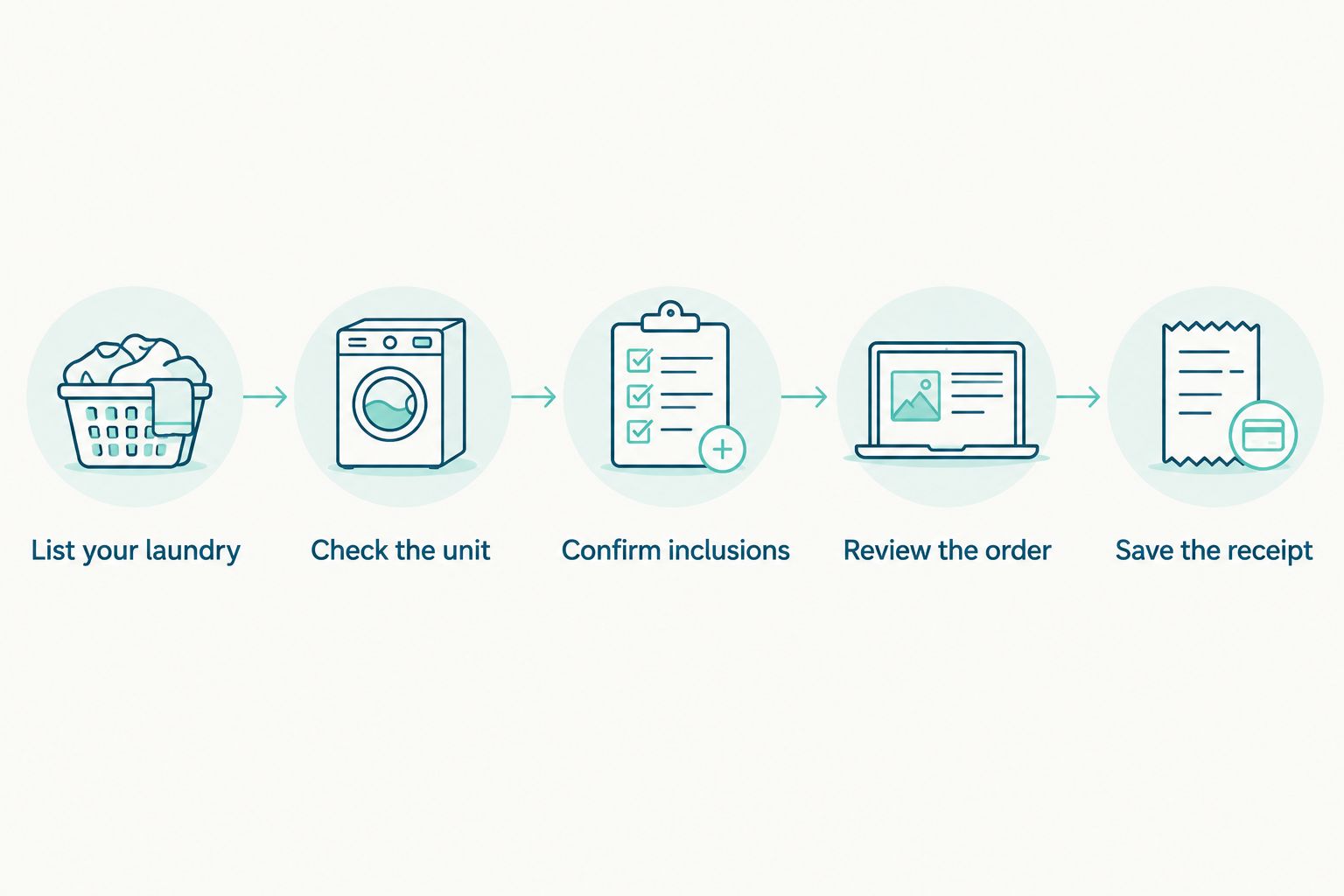
Use the same planned laundry order for both comparisons. Changing the contents halfway through makes the comparison less useful. Follow this sequence before your first pickup.
- List your laundry. Identify everyday clothes, towels, bedding, and anything with care instructions that need attention. You do not need to inventory every sock; you do need to flag an item that changes the request.
- Check the unit. Ask what the provider measures and how it defines the boundary. For weight, ask about weighing; for loads or bags, ask about capacity and overflow.
- Confirm inclusions. Check the services and handling you want against the written order terms. Make sure pickup and return delivery are addressed rather than inferred.
- Review the order. Read the summary before confirming, including any minimum requirement or separately handled item. Resolve unclear wording while you still have the laundry at home.
- Save the receipt. Keep the recorded quantity and order details. That gives you a useful reference when planning a similar batch later.
This process gives you a practical 2026 comparison without relying on another household’s laundry habits. Your own order is the relevant test case.
Is laundry charged by weight cheaper than laundry charged by the load?
Neither billing model is automatically cheaper. You need the service’s current terms and the same laundry order to make that comparison. A unit label alone cannot settle it.
For weight-based service, focus on measured quantity and any minimum. For load- or bag-based service, focus on how your batch fits the defined boundary. Then check that both comparisons include the same services and special-item handling.
Choose based on the complete order and the amount of planning you want to do. A clearly explained model you can use consistently is more practical than a vague promise that one unit always wins.
Does one bag of laundry count as one load?
One bag does not automatically equal one load. Bag size and the provider’s load definition determine whether those terms line up. Your usual hamper is not a universal measuring cup.
Ask the service to explain how it would count your planned bag before pickup. If the answer refers to a size, weight limit, or closure requirement, use that specific rule rather than your home washer as the reference.
Are blankets and comforters included in regular wash and fold?
Do not assume blankets and comforters follow the same rules as everyday clothes. Check item acceptance, care-label requirements, and billing treatment before putting them in the order.
Keep those questions separate: accepting an item does not explain how it is counted. If you regularly send bedding, include it in your comparison from the start rather than treating it as an afterthought.
Choose the service model separately from the billing model
You are making two decisions: how laundry is counted and how much of the chore you want someone else to handle. A clear billing method matters, but so does whether you want to transport, wash, dry, and fold the clothes yourself.
Hampr is best for households and businesses seeking wash and fold with pickup and delivery. The service operates in select US cities, so check the service information for your area before planning around it. Do not infer a local billing method or item policy from the general service description.
If pickup and delivery are your goal, confirm those arrangements alongside the quantity rules. Then compare the order you actually want, not a stripped-down version that leaves you doing part of the chore.
FAQ
How does wash and fold priced by weight work?
Wash and fold priced by weight uses measured laundry weight as the billing quantity. Check the provider’s weighing process, minimum-order terms, and treatment of special items before booking.
Is per-load laundry billing the same as per-bag billing?
Per-load and per-bag billing are not automatically the same. A load needs a capacity definition, while a bag needs container and packing rules; check whether the provider explicitly equates them.
Can I weigh my laundry before pickup?
You can weigh your laundry at home to estimate its weight. Treat that reading as a planning aid, not a replacement for the provider’s recorded measurement.
Does wash-and-fold billing include pickup and delivery?
The billing unit does not tell you whether pickup and delivery are included. Check the complete order terms for both parts of the trip before confirming.
Should I combine small laundry orders into a bigger pickup?
Check minimum-order and capacity rules before combining batches. Keep care instructions and item restrictions in view rather than assuming a larger batch is always the better choice.
What should I check before booking wash and fold in 2026?
Before booking wash and fold in 2026, check the billing unit, minimum-order rules, included services, and special-item handling. Keep the order summary so you can compare it with the completed receipt.
Does Hampr provide laundry pickup and delivery?
Hampr provides on-demand laundry pickup, washing, folding, and delivery for households and businesses in select US cities. Check the service information for your area before arranging an order.
One last thing
Ask the provider to explain exactly how it would count the laundry you intend to send. That single request tests whether the billing terms are clear enough to use. You should finish the conversation knowing the unit, the boundary, and what happens if your order crosses it.
For your first order, save the description you booked alongside the final receipt. That gives your next laundry day a useful starting point: your actual laundry, not someone else’s estimate.